Do Words Good — Swipe File
dowordsgood.com/copywriting-swipe-file
Hexclad
HEXCLAD’S REALLY CLEVER PRODUCT DESCRIPTION TRICK
What's good about it
This is one of those subtle bits of copy that hides just how clever it is.
You see, while you've probably heard the phrase "sell benefits, not features" a thousand times, there are times you should lead with features.
For example:
👉 When you’re selling a product that you know customers are thinking about very logically (like-for-like shopping, feature comparisons, etc…)
👉 When you’re selling a product to customers that are very category or product aware
👉 When your audience isn’t one audience at all, but a mix of customers across the stages of awareness all landing on the same page
👉 When your product has a technical side that properly matters (and that skipping would make you look vague or fluffy)
All of those situations are proven to require differing degrees of leading with the features.
In fact, decades of research shows that prior knowledge of your product or category fundamentally changes how people process information about your product and make buying decisions.
TLDR: studies show that the more category knowledge customers have, the more they rely on specs and features over benefits.
Put another way, some customers are scanning for specs to validate a decision to buy your product, while others are searching for language that helps them imagine using it before they start to justify and validate and buy.
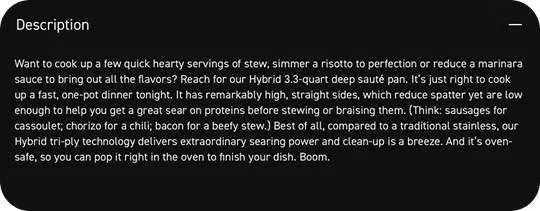
And Hexclad's super smart product description manages to balance that perfectly with just a few three-word phrases: "so you can" and "to help you".
How to use this for your brand
Hexclad's audience is made up of chefs, home cooks and people who just want good equipment in their kitchen. (And, we'd wager, a lot of Gordon Ramsay fans.)
Which means there's a split between people who need to read benefits and people who need to read features.
Which puts them in a bit of a pickle.
They could go all features and write something like: Perfect for quick weeknight dinners and slow weekend braises. Gets a restaurant-quality sear on your proteins and makes cleaning up afterwards a breeze.
Which is warm and readable and sells the lifestyle, but it's vague for chefs and home cooks. It tells you nothing about the specs or the features that they look for.
But on the other hand, something like: Remarkably high, straight sides. Hybrid tri-ply technology. Oven-safe construction.
It's feature-rich and great for the more aware buyer, but it reads like a spec sheet. The new customer has no idea why any of that matters to them or what it means for their Tuesday night dinner.
So Hexclad do this clever trick where they bridge specs and features with the benefit. With "so you can" and "to help you", Hexclad manage to name the feature (for the people scanning for specs), explain what it does, and then paint a picture of the payoff (for the less-aware buyers). It's really smart. And it's a trick you can pinch whenever you're selling something that's a little more complex than an impulse purchase. Just go: Feature → why it matters → so you can → show the result. Oatly do it with their barista milk: This carton of Barista Edition Oatmilk is made from liquid oats which means it isn’t overly sweet or excessively heavy. What it is, is fully foamable putting you in total control over the density and performance of your foam so you can showcase your latte art skillz, sorry we mean skills. Glossier do it too: Once the formula sets, it's water-resistant, transfer-resistant and lasts up to 12 hours - so you can spend more time doing you, and less time doing touch ups. What does your version of that look like? How can you stitch together your features with benefits and paint a picture of the end result?