Do Words Good — Swipe File
dowordsgood.com/copywriting-swipe-file
Candy Kittens
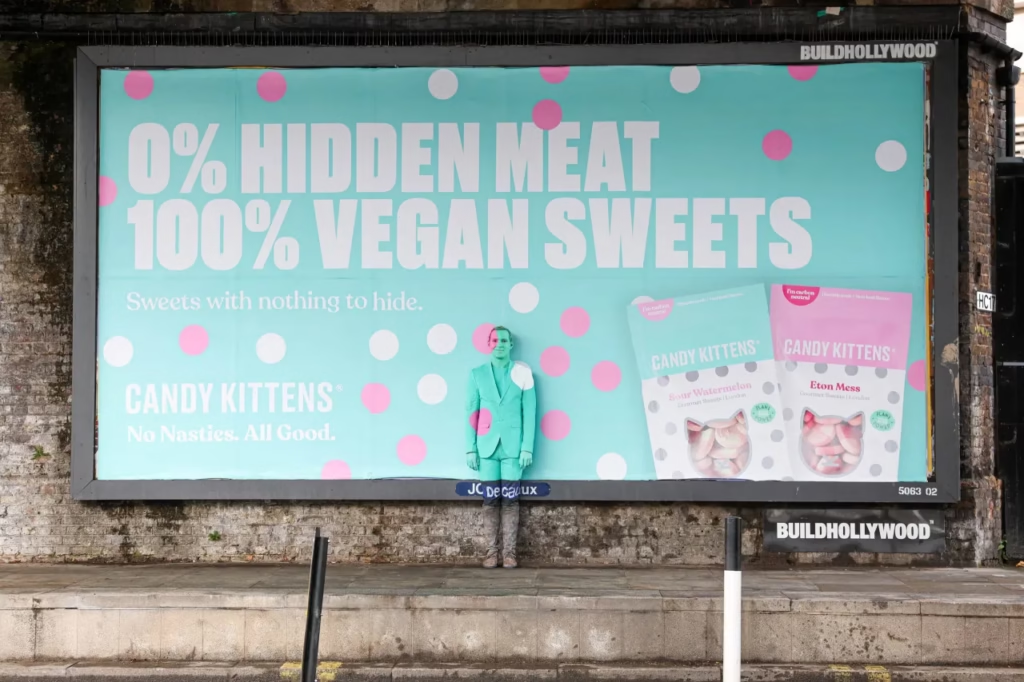
CANDY KITTENS’ RESEARCH-LED OOH CAMPAIGN
What's good about it
We'll be honest, we wrote Candy Kittens off at the beginning as just another celebrity brand flash in the pan.
They've consistently proven that wrong, year after year.
How to use this for your brand
This is a theme that's been cropping up throughout the swipe file: there's messaging for when you're launching, there's messaging for when you're growing and then there's messaging for when you're scaling.
Put another way, there's the messaging that builds your tribe that's specific, values-led, speaking directly to people who already love what you stand for.
And then there's the messaging that gets you to scale that is broader, more universal, and tailored to the person who doesn't know your brand yet and doesn't particularly care about your mission.
And Candy Kittens are a really good example of that evolution.
In 2012, they launched as a premium sweet brand, mostly built off the back of having celeb co-founders. That was their ground floor messaging: really good sweets, founded by two celebrity mates.
Then, from like 2016-ish, they introduced being vegan, removing animal products and becoming a B-Corp. Their messaging was about being really good sweets that are meat-free, eco-friendly and founded by celebrity mates.
But, like we saw with Dash's OOH campaign, sometimes the messaging that gets you to the point of having product market fit is also a ceiling.
Once you're the number one sweet choice for vegans, where do you go? How do you sell to all the non-vegans without losing your audience or fundamentally changing your brand?
To figure this out, Candy Kittens commissioned research that found 67% of consumers are unaware that their favourite sweets contain animal products.
Or, as co-founder Jamie Laing said: "Most of the sweets industry is full of gelatine. It's hidden within sweets masked behind bright colours and playful cartoons and vague on-pack ingredients."
Thus, this hidden meat idea was born.
It's so clever because it does a few things at the same time:
1. It's immediately hooky and attention-grabbing
2. It's an eye-opener that sweets contain meet to their new, bigger audience
3. It's a really effective reframing of an ethical argument into a tactile one. (Because the thought of biting into a meaty sweet is almost grotesque, gut-response. The ethical argument is more intellectual.)
4. It's educating their new audience by teaching them something new
Which is really clever, because research found that educating customers and teaching them something they didn't know directly increases loyalty and word of mouth. That's because they feel smarter. (And we like sharing things that make us look smart.)
Almost every word in this campaign is really cleverly engineered to raise awareness, grab eyeballs and convert people from eating sweets that contain meat.
Properly smart stuff.
And even better, it's not even a messaging shift for Candy Kittens.
They haven't changed what they believe. They haven't had to do new website, new packaging, new emails...
They've just found a way to make their top of funnel content bigger and widen their circle of potential customers. (Which, as we always say, is the basic Byron Sharp idea of how brands grow. Not through being the #1 choice for hardcore fans, but by appealing to more people.)
Which means there are two lessons you can nick here:
1. Is there anything your wider audience doesn't know about your category that would make them look at it completely differently? Any shortcuts? Any trade-offs? Any industry secrets? Can you use those to open their eyes and nudge them towards you?
2. This one is a bigger strategic question: what stage are you at? Are you still building your tribe? Are you compounding your messaging to be the #1 choice for your tribe? Or are you going for the bigger, broader messaging to appeal to the most people?
We know it sounds more like a growth question than a messaging one. But it makes a huge difference in the way you approach your copy.