Why we love this
 Why we love this
While our raving days are well behind us (and, frankly, raving days is an exaggeration), when we saw this bit of copy, it went straight into the swipe file.
It's just so crystal clear on what it is and who it is for. Love it.
Steal this for your brand
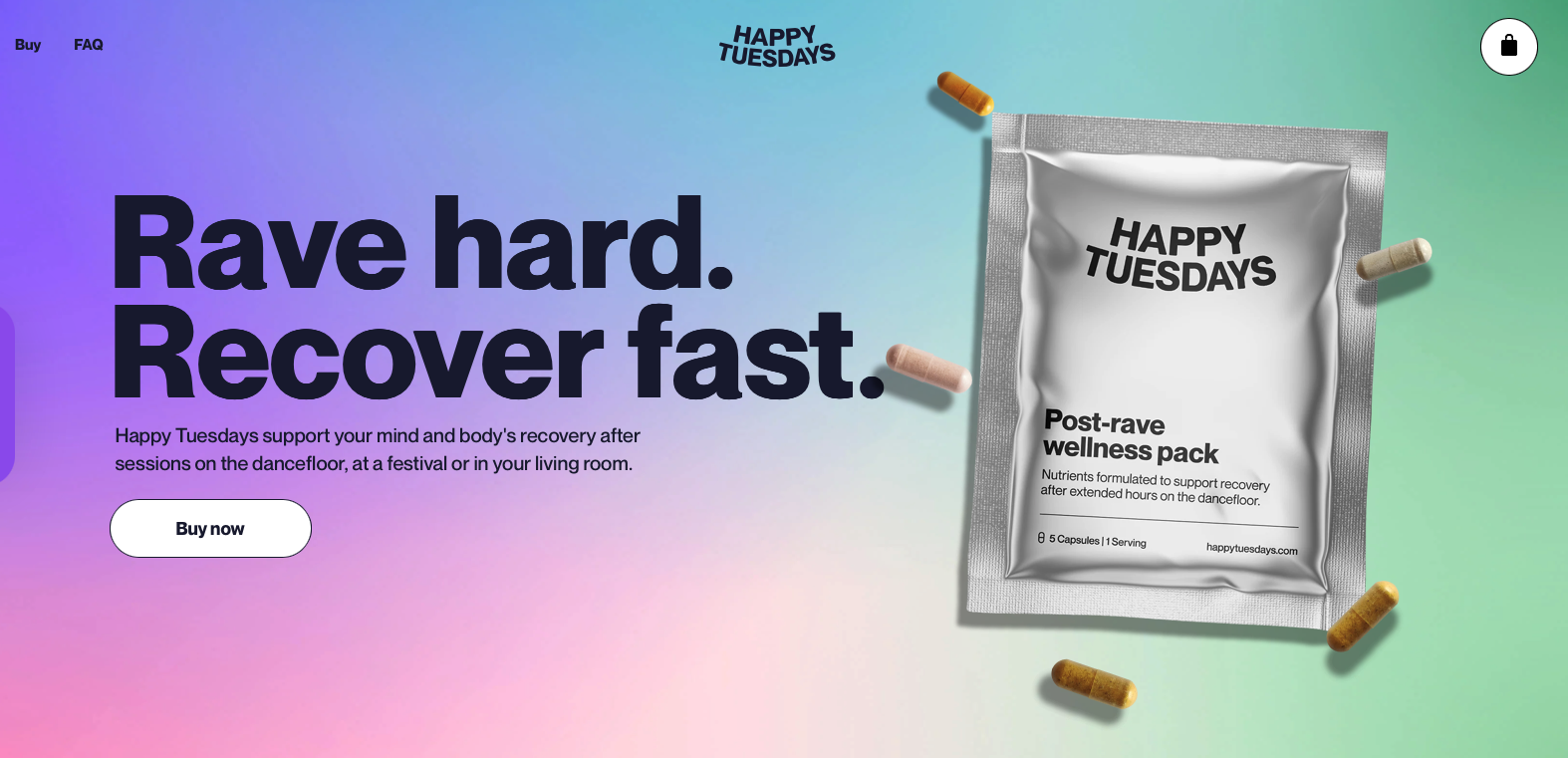
There's lots of stuff we could say about this 4-word headline, but we'll focus on the thing we love the most: it knows with absolute clarity who it's talking to.
It's not talking about partying. It's not for hangovers. It's not for people that work too hard or push too hard at the gym. It's not for biohackers. It's not for supplement stackers.
It's is just talking to people who rave.
And by doing that, it's so easy for them to hit those "we're the brand for you" beats in their copy.
While other wellness brands have to say "live your best life" and other vague-isms to appeal to everyone, Happy Tuesdays can be super specific in their copy.
Look at "support your mind and body's recovery after sessions on the dancefloor, at a festival or in your living room."
"Sessions", "in your living room"... these little details are things you can only say that if you know exactly who you're talking to and you know how they talk.
It's also super smart because studies show that we love brands that talk like us.
👉 Rodríguez-Díaz et al. (2022) showed that when your copywriting style and word choices match the linguistic style of your audience (in tone, syntax, even rhythm) they become more persuasive and lead to greater customer satisfaction post-purchase (AKA, better reviews, less returns and more social proof.)
👉 Professors John Bryden, Sebastian Funk and Vincent Jansen found that social tribes naturally develop unique vocabularies to signal who’s “in” and who’s not, even down to unusual spellings, emoji choice and punctuation style.
(Side note: Dr Sebastian Funk is a 11/10 name. We bet he plays the bass.)
This is because, psychologically, when someone (even a brand) starts using our kind of language — things like sentence length, rhythm, even filler words — we subconsciously feel closer to them.
(It’s why even the FBI use it to negotiate hostage releases because it improves the chance of a successful negotiation.)
👉 This whole concept is called Communication Accommodation Theory and it’s been the case since we left the caves and developed language. We adapt the way we talk to bond with people faster and create connections.
Which is why it’s a good idea to adjust and adapt your copy to how your audience think and talk.
👉 It's important to note that recent studies have found that trying too hard to adjust your communication style is more likely to backfire than to win you customers. As a 2025 Journal of Marketing study found, brands that try to shoehorn in slang or youth language (like “rizz” or “slaps”) can backfire.
So, this 4-word headline kinda contains two lessons:
1. Make sure you're absolutely crystal clear on who you're talking to. (Pro tip: motivations and rituals and mindset > demographics.)
2. Find a way to weave the words they use into your copy naturally and without trying too hard.