Why we love this
 Why we love this
We've always hated Problem-Agitate-Solution as a copywriting formula. (It's that agitate part that feels icky.)
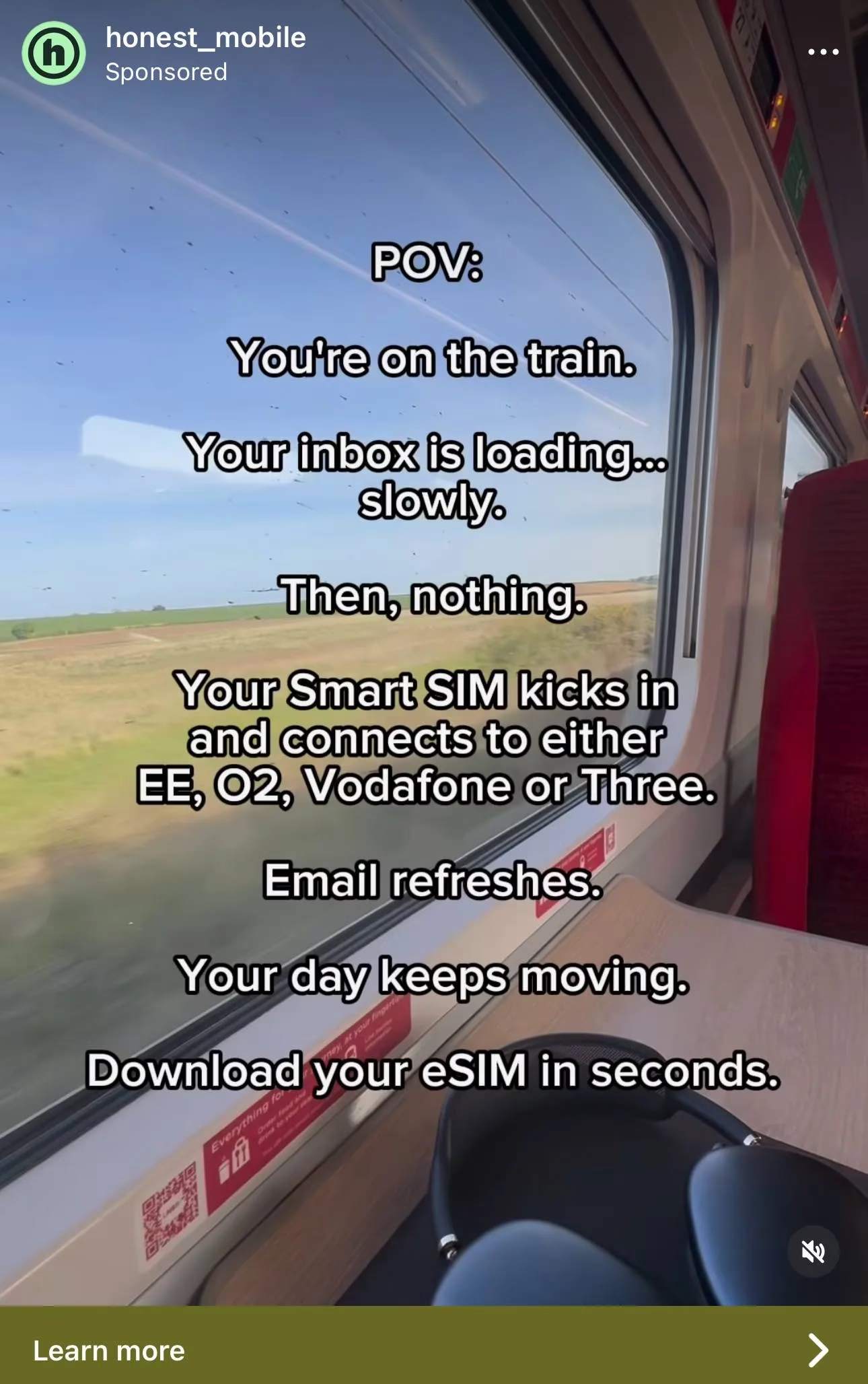
So when we got hit with this Honest Mobile ad that manages to talk about pain points without it feeling gross, we hit screenshot lickety-split.
It's such a good example of the before-after-bridge copywriting formula. Love it.
Steal this for your brand
The standard piece of advice when it comes to writing copy that sells has always gone a little something like this:
Find your customers’ biggest pain point. Agitate it. Make that pain feel real so the customer wants to fix it immediately. Then present your product as the solution to that agitated pain.
And 50 years ago? It 100% worked. And in certain niches? 100% still works.
But nowadays? Not so much.
Studies have found that audiences are becoming more and more turned off by ads and copy that feel manipulative or like they’re pushing too hard.
But at the same time, talking about pain points and showing how your product solves them is still a good idea.
It’s that agitation part that gets sticky. Because it’s really hard to agitate a pain point without slipping into manufacturing a consequence that feels icky.
So, how can you get all of the pain point benefits without going full Leo in Wolf of Wall Street?
By swapping the classic Problem-Agitate-Solution copywriting formula for the Before-After-Bridge (B-A-B) approach.
And that's exactly what Honest Mobile do here.
The ad opens with a customer’s POV before they tried Honest Mobile’s eSim. In this case, it’s being stuck on a train with no signal.
Notice how this is an almost universal pain point, but because it’s framed as a story, we fill in the blanks on our own.
Instead of saying the consequences of having no signal, Honest Mobile let our brains imagine whether we’re impatient for a reply from a client, waiting for a reply from your boss, waiting for an email to say we had an offer accepted on a house…
The context switches depending on who reads it. That’s super clever. It allows us to experience the pain point, rather than having it agitated for us. *chef’s kiss*
Then, they resolve that tension and give us a glimpse of what our world would look like after that problem goes away. And again, because it’s a narrative, our brains fill in the blanks on all the ways our lives would improve with it. (“I wouldn’t have missed that email if I’d had this!”)
Finally, they wrap it up with a bridge between the before and after by saying “Download your eSim in seconds.”
In 36 words and 6 seconds flat, they’ve told a full story that’s allowed us to experience the pain of not using their product, imagine our lives being better with it and then showed us how to take action.
This is called experiential copywriting, where copy makes the reader mentally simulate using or experiencing a product rather than learning about the product.
Studies have shown that this leads to significantly stronger purchase intentions than analytical, feature-based copy. Essentially, our brains rehearse the experience of using the brand before we buy it, which creates a feeling of familiarity and desire for that product. Smart, eh?
We 💛 this formula because it’s so effective and so damn simple to execute.
And for busy social teams, it makes life as simple as finding a quick background video, overlaying some text and hitting publish. 5 mins from start to finish to a super-effective storytelling ad. Boom.
Here’s how to steal it for your brand:
Set up the before: pick a situation where your customers’ pain points are at their pointiest. Think of real, lived-in moments that your customers can relate to.
Then, write a short line or two that sets it up so they feel like they’re experiencing it.
(Pro tip: address the customer directly and drop them directly into the action. This is a writing technique called in medias res, where you bypass the traditional exposition to start the story at a point of high tension or action. It’s used to grab the audience’s attention quickly and create suspense, mystery, and a sense of immediacy. AKA, perfect for ads.)
Sell the after: do the same thing, but opposite. Find a situation where that pain point is completely eradicated. Then write another line or two where the customer can feel that relief. But don't describe the relief, describe the feeling.
It's not "you can rest easy knowing it's taken care of". It's "feet up, podcast on, daydreaming out of the window".
Show your product as the bridge: write one line that shows your product as the bridge between the before and after.
That's all there is to it.
Super, super simple. And super, super effective.
PS. We did a deeper dive into this technique and this ad on our blog if you want to get into the weeds.