Hexclad
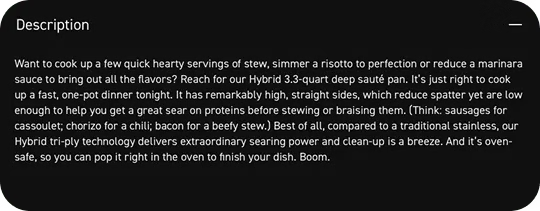
Hexclad’s really clever product description trick
This is one of those subtle bits of copy that hides just how clever it is.
You see, while you've probably heard the phrase "sell benefits, not features" a thousand times, there are times you <em>should </em>lead with features.
<strong>For example:</strong>
👉 When you’re selling a product that you know customers are thinking about very logically (like-for-like shopping, feature comparisons, etc…)
👉 When you’re selling a product to customers that are very category or product aware
👉 When your audience isn’t one audience at all, but a mix of customers across the stages of awareness all landing on the same page
👉 When your product has a technical side that <em>properly</em> <em>matters</em> (and that skipping would make you look vague or fluffy)
All of those situations are proven to require differing degrees of leading with the features.
In fact, decades of research shows that prior knowledge of your product or category fundamentally<em> </em>changes how people process information about your product and make buying decisions.
<a href="https://journals.sagepub.com/doi/10.1509/jmkr.47.2.301" target="_blank" rel="noreferrer noopener"><strong>TLDR: </strong>studies show that the more category knowledge customers have, the more they rely on specs and features over benefits.</a>
Put another way, some customers are scanning for specs to <em>validate</em> a decision to buy your product, while others are searching for language that helps them <em>imagine</em> using it before they start to justify and validate and buy.
And Hexclad's super smart product description manages to balance that perfectly with just a few three-word phrases: "so you can" and "to help you".
See how to use it ➔