How to beat writer’s block when you’re writing copy for your ecomm brand
Keep hitting writers’ block? Here’s why a messy swipe file might be your secret weapon to writing better copy, faster.
💡This week’s big idea: keep bumping into writers’ block? Start keeping a swipe file of copy you love.
Remember a few weeks ago when we discussed that the key to getting your message remembered was to stay on-song?
In other words, pick your big idea and find a million different ways to say it?
(Sarah Carter calls this disguised repetition AKA say the same thing in different ways all the damn time.)
And, as WARC points out, consistent brands are six times more likely to report “very large brand effects“ (AKA, awareness, differentiation, values and salience) as the advantage compounds over time.
The trouble is, once you’ve pinned down your big idea and decided to follow the evidence and keep repeating it…
…you’ve made your life a lot harder.
Because coming up with new messages is easy.
(In fact, it’s sometimes almost too easy. Which is kinda the problem.)
Finding new ways to say the same thing is a lot harder.
Which is why we love keeping a good swipe file. (AKA, a semi-organised collection of bits of copy you’ve collected from in the wild.)
For us, having an on-tap resource for inspiration, ideas and a touch of creative borrowing is an absolute game-changer for coming up with new ways to say the same thing.
And the best bit? It’s backed by how our brains and creativity work, too.
👉 Creativity isn’t magic, it’s about combining existing ideas into something new. Research into creativity shows that creative thinking is our brain forming new combinations of existing elements. And the more raw material your brain can access, the more interesting the combinations tend to be.
👉 The most creative people aren’t wired differently, they just have different points of reference. When researchers look at brain networks, higher-creative people tend to have more flexible, richly connected networks than lower-creative people. In other words, creative people can “jump” between ideas more easily because they have more points of reference.
👉 Examples make you faster because they reduce cognitive load. When we’re learning or doing a task, our brains do something called the “worked example effect”. In other words, we can learn and do complex tasks more efficiently when we can study good examples, because it helps us know what good looks like and gives us something to imitate. And a full swipe file gives you on-demand access to that worked example effect.
TLDR: having a swipe file means you can swap staring at a blinking cursor on a blank page with something that’s going to help you spark new ideas, write better copy and come up with messaging concepts that other brands (and AI) just can’t.
But there are a few things that separate a really good swipe file from a glorified Pinterest board.
Let’s dig into it 👇
A quick tangent: why swipe files matter more than ever in the age of AI
AI & copywriting is a complex topic that’s far bigger than this email.
But ethics aside, one thing is quite clearly true: AI has made it easier for brands to do copy better.
7-ish years ago, having good copy was still a bit of a differentiator for brands. There were lots of websites with amateur-ish copy and typos and mistakes.
Now? Most of that is gone. And that’s because every brand can get ChatGPT to throw out some ideas, cut the em-dashes and hit publish.
Sometimes it’s a bit slop, yeah. Sometimes it has AI tells, yeah.
But the copy isn’t technically bad. And, on the whole, it’s a lot better than most of the copy published by brands at similar stages a decade or so ago.
The big problem with that copy is that it’s almost generic-by-design.
Under the hood, large language models generate text by predicting what word is most likely to come next given the context. That means they’re very good at producing copy that sounds like your category and blending in because it’s designed to echo things that have been done before.
And as more brands write their copy with AI, you end up with a category more and more jam-packed with the same thing said in almost the same way with the same tone of voice.
But with a swipe file, you have a way out of that noisy middle.
You have a way to spot and come up with interesting new ideas and say them in a way that makes you stand out, even if you don’t feel naturally “creative”.
And that’s an absolute game-changer.
How to create your writers’-block-tackling swipe file
First up: please don’t let anyone convince you there’s a “correct” way to do this.
And you definitely don’t need a $29 subscription to do it.
If your swipe file lives in a Notion doc, great.
If it’s a Figma file, great.
If it’s a Pinterest board, a brain dump in your notes, a file in your camera roll, a Slack channel called #inspo… crack on.
Because, ultimately, the best system is the one you’re actually going to use when you’re busy, under-caffeinated, and trying to write something by EOD.
The only real rule is: fill it with copy that makes you feel something.
Not just “this is well written”.
And not just “wow, I love this”.
Nab screenshots of the posts that catch your attention as you scroll. The headline that makes you think, damn, that’s good. That tube ad you always read. Even the social posts that have thousands of likes but you can’t fathom why.
Most of all, include some of the stuff you don’t personally like. (Not only is this good for helping hone your own voice, but it’s a great creative exercise to go “How can I turn this into something I like?”.)
And how you organise it is up to you, too.
Again, there’s no right or wrong way here, either.
Best practice (and other articles about swipe files) would tell you to organise your swipe file like a library.
Make tabs for subject lines, sections for PDP heroes, little sub-categories for each different copy job.
And if that works for you, happy days.
But for us personally, the pressure to have a perfect system set up can be a blocker for us actually getting it set up.
So, in the hopes it’ll make you feel better, we’ll say this: ours is a complete shit show.
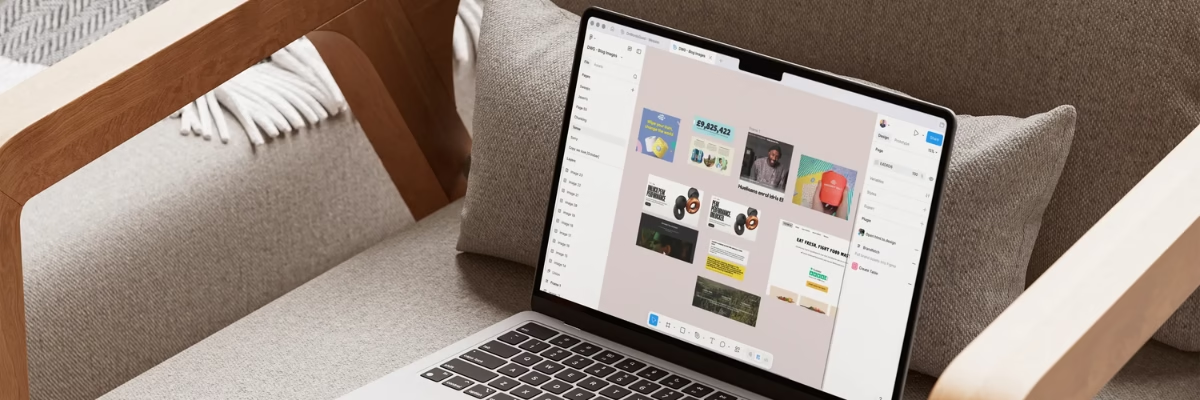
It is literally just a Figma file full of screenshots and bits of copy we’ve found interesting.
(A lot of which have found their way into these newsletters, actually.)
But what started out as “we’ll start this and organise it later” has actually turned into a huge bonus for us.
Because if you only ever look at the “right” kind of swipe copy, it’s easy to end up writing copy that’s still a little generic.
For example, if you only look at your PDP swipes when you’re writing a PDP, you’ll get very good at writing PDPs that sound like other PDPs.
But we found, quite by accident, that the more interesting copy ideas tended to arrive when we weren’t looking for something specific, but going in curious. Less “let’s find a headline idea” and more “let’s go see what ideas this sparks”.
A lot of the time, a headline we saved to use as headline inspo finds its way into an email. Sometimes an email preview text becomes an about page. Sometimes a social media hook becomes an h1.
That kind of cut-up technique (as it’s called in poetry) is a game-changer for beating that writers’ block that comes when you have to find a new way to say old things. That’s because you’re no longer inventing out of thin air or asking “what new ways can I say this?”.
You’re just remixing and reusing ideas that you already know are pretty damn good.
The real pro tip: don’t just include copy from your category
This is the bit that makes a huge difference.
There’s a well-known quirk of human behaviour called design fixation, which basically tells us that when we see examples, we end up copying surface features without realising it. Even if we’re consciously trying to be original.
Which means that if your swipe file is full of just ecomm/FMCG copywriting, it’s quietly training you back to category-blending copy AKA the exact thing we’re trying to avoid.
That’s why our swipe file is deliberately eclectic as hell.
There’s headlines from SaaS sites. Old print ads. Bits of packaging we’ve seen in the supermarket. Newspaper headlines. Little bits of personality-heavy UX microcopy. Social media posts. Lines from sitcoms or books we’ve read. Pithy quotes from reviews. OOH ads we see on our travels. In-store notes like this one from somebody at Jack’s local B&Q…

And that wide range of sources of inspiration is something no AI model or even copywriter on a deadline would immediately think to use as inspiration to write your next headline or subject line.
And that’s exactly the point.
It gives your copy the edge. It helps you stand out and say something new and fresh without it feeling like a chore.
Fun fact: Back in the early days, circa 2016, we did a website for a LARP business (two absolute legends who ran huge meet-ups of Hobbits and wizards across North America). All of their competitors (of which there were a fair few, surprisingly) had very same-y messaging, so we ended up pinching a headline from Slack’s early days and combining it with a Crosby, Stills, Nash & Young lyric and a subtle Tolkien reference to end up with something that resonated so much with their audience, it became their best-selling bit of merch.
☝️ That’s what happens when you make sure you’re deliberately keeping your references broad.
So be curious.
Make an active effort to try and notice copy wherever you see it and, pretty soon, you’ll be doing it on autopilot and have a huge swipe file to draw on.
🧠 Want to kickstart your swipe file? Start here.
We should say that the best copy for your swipe file is usually found organically.
But if you want to kickstart your swipe file with an injection of sweet, sweet inspo, here are a few places you can start:
Harry Dry’s Marketing Examples: one of the OG bits of inspiration for this very newsletter, Marketing Examples does a great job of pulling tiny bits of copy and giving you a tiny explanation why they work. Some of it leans a bit old-school, but there are loads of gems in there.
Pinterest: not just for outfit inspiration and planning your next renovation, Pinterest is also a treasure trove of copywriting examples. You have to filter through a bit of self-promo, but there’s loads of nuggets.
SaaSLandingPage.com: this is an absolute banger of a site for making sure you’re keeping your frame of reference broad. It’s chock-a-block of lots of SaaS websites broken down by page. So many bits of copy to screenshot and use as creativity fuel.
How to use your swipe file in the fight against writers’ block
Writers’ block is the worst.
But, hand on heart, neither of us have had writers’ block for years.
(At least not professionally. Jack had to send a text the other day that took him 30 mins to write.)
Why? Because as soon as we start to spin our wheels in the mud, we’ll open our swipe file and pull out, say, five to ten bits of copy that catch our eye.
Then, just like we’ve said before, we act like magpies.
We’ll write a very direct, 1:1 rip-off of everything for the brand we’re working with.
Now, this copy will never see light of day.
But what it does is get us out of stuck mode and into creative mode.
And because we know it’s never going to be seen by anyone but us, we don’t get precious about it. We know we’re not trying to write “the one”, we’re just kicking around an idea.
Then we move on and do it again. And again.
After a few of those, we’ve gone from “we need an idea” to “we’ve got a little pile of options”.
And even though more than half of them are more than a little bit ropey, it doesn’t matter, we’re no longer stuck.
Then, you look back at the ones that work and almost always end up taking a phrase from here, a hook from there and the structure of another idea and combining them into something novel and original.
A remix of a remix, as it were.
So yeah. If you’re stuck, don’t try to be brilliant. Don’t even try to be original.
Open your swipe file, steal a few ideas, do a bad cover version and then do your own remix of your cover versions.
☝️That’s almost always how the really good stuff turns up.