Steal Botivo’s sentence-level storytelling trick
Learn how sentence structure shapes the mental movie in your reader's mind and how to use it to write copy that lands.

💡 This week’s big idea: brand storytelling is so much more than your origin story or your product stories.
We know. We know. You don’t need us to tell you how important brand storytelling is. You’ve got an inbox and a LinkedIn feed full of people saying that already.
(No judgement here. We’ve written on it before when we looked at Lucky Saint’s brand story.)
And don’t get us wrong. We love a brand that’s got an origin story, a world, a reason to exist beyond selling their stuff…
But most of the conversation around brand storytelling only lives at that zoomed-out, macro level.
The big sexy brand narratives. The story-led campaigns. The founder-led brand origin stories… you know, actual stories.
But we read something recently and it’s got us noodling whether it’s useful to think about storytelling as more than that.
We came across this idea from a cognitive scientist called Benjamin Bergen that was featured in Will Storr’s The Science of Storytelling.
He says that storytelling starts at a sentence-level with how we structure our sentences.
And it’s not even about the words we use. It’s not about golden vs yellow. That’s another conversation for another day. This is quite literally about the structure of your sentences and how our brains process them.
Because Bergen’s peer-reviewed research found that when we read, we don’t wait until the end of a sentence to start creating a mental image.
Instead, he says that our brains push play on the movie in our minds as soon as we read the first word of a sentence.
Not quite following? We were the same. (Especially when it started using phrases like transitive vs ditransitive construction.)
But the easiest way to think about it is to compare these two sentences:
Jack sent a Slack message to Joe
vs
Jack sent Joe a Slack message
See how in Option 1 we can picture Jack typing then hitting send then Joe getting the message, just like it would play out in a film?
But with Option 2, we have to hold this intangible idea of Jack sending something to Joe almost as a theoretical concept in our minds until we have all the details for a full picture at the end of the sentence.
And although it’s quite a subtle difference, Bergen found that our brains much prefer sentences like Option 1 because they’re easier to imagine, understand and to process.
(Which lines up nicely with processing fluency too. The easier something is to understand, the more we like and trust it.)
And, more interestingly for our purposes, the difference between the two sentences is also about whether we process it as a rational thought or on a more gut/emotional level.
Bergen argues that it isn’t just that it’s slower to process sentences like Option 2, but we also end up with a much muddier picture in our minds after reading them (or no picture at all).
Which means that while these two bits of copy might feel like they’re saying the same thing…
Your skin barrier loses moisture every day. The ceramides and niacinamide in our daily face cream put it back.
Formulated with ceramides and niacinamide to restore and protect the skin barrier.
… but we bet only one had you actually imagining dry then restored skin, right?
And so, when we’re all trying to write copy that makes our products tangible and to use our copy to paint a picture of how customers will use it in their day-to-day lives, sentence structure is almost as important as the words we use.
And, unsurprisingly, Botivo — a brand that we’ve looked at before for their picture-painting words — do this really well.
Let’s dig in.
How the best bits of Botivo’s copy put you right in the story from the very first word
We’ve waxed lyrically about Botivo’s Yellow Hour copy before.
In that article, we talked about how they use their copy to create a ritual and move their drink out of just the AF category and all that other good stuff.
Fun fact: writing up the swipe file version of that post is what led to this newsletter idea. We were like “oh look, a transitive sentence! And another!”
And while chances are very slim that they had a meeting where they discussed using transitive sentences and filmic language on their website, their team clearly has an instinct towards using powerful, emotional, evocative language that puts us in the scene.
Look at this absolute beaut from their about page 👇
Each thyme leaf hand-picked, each blend hand-made, each bottle hand-dipped in wax.
As you read that, your mind plays a movie-style montage of the drink being made right? You can imagine the noise of the thyme leaves being picked, the hands doing the work, the care and love going into the process. You’re probably imagining a grainy flicker and that golden hour glow like it was shot on film. In our heads, it’s almost like a Terrence Malick film.
And even their other, less-picture-paint-y sentences (like “Whatever the time on the clock, you’re clocking off.” and their founder’s “When I tried Botivo it blew my mind”quote ) will quite often follow this filmic, easy-to-imagine chronological structure.
Which makes this section on their homepage very interesting 👇
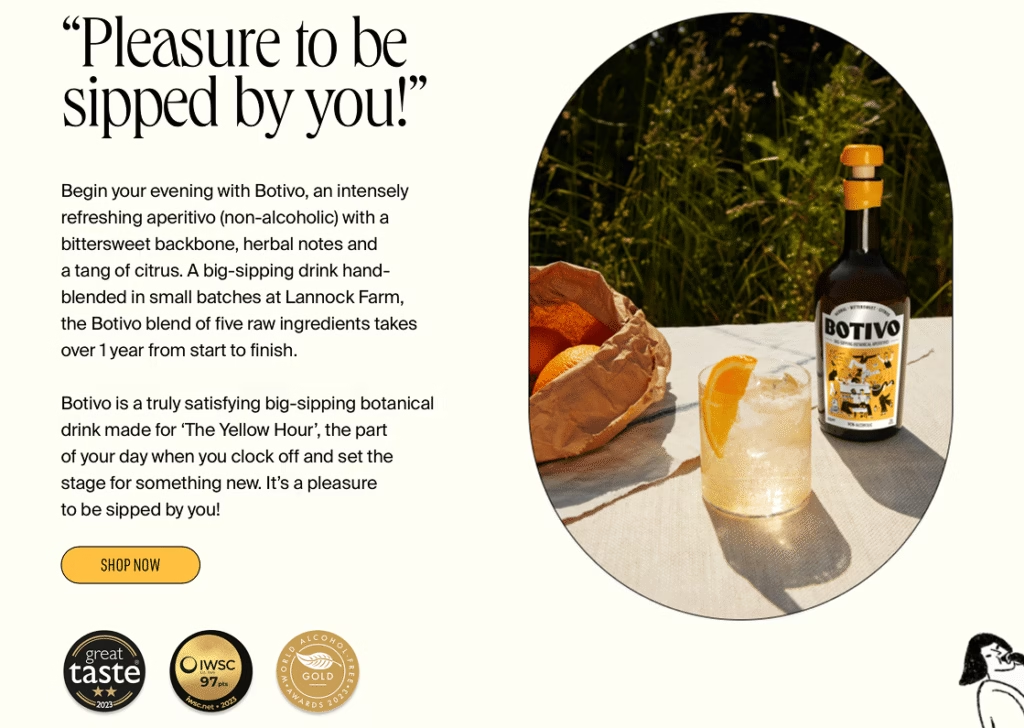
Now, this is a big, important section on their homepage that’s being asked to do a LOT of work.
It needs to tell the story, show the process, set up The Yellow Hour, do that time-cue thing we’ve talked about before…
… and in the pressure to do all that, that mental movie clarity that they nail all over the site gets a little muddled.
It starts off strong with “Begin your evening with Botivo”. Immediately, our brains start playing a film of us, after work, drinking a Botivo. Amazing.
And later on, we get “the part of your day when you clock off and set the stage for something new” too. That does the same thing, you’re finishing work and Botivo is helping you shift from work mode into chill mode.
But in the middle, things feel like they’re trying to do a lot of things at once. And in that busyness, we end up losing that crystal clear movie that was playing in our brains.
Luckily, all it takes is a tiny rewrite with this sentence structure in mind and, pretty damn quickly, you have something that ticks all of the same boxes, but is much easier for our brains to process.
Check it out 👇
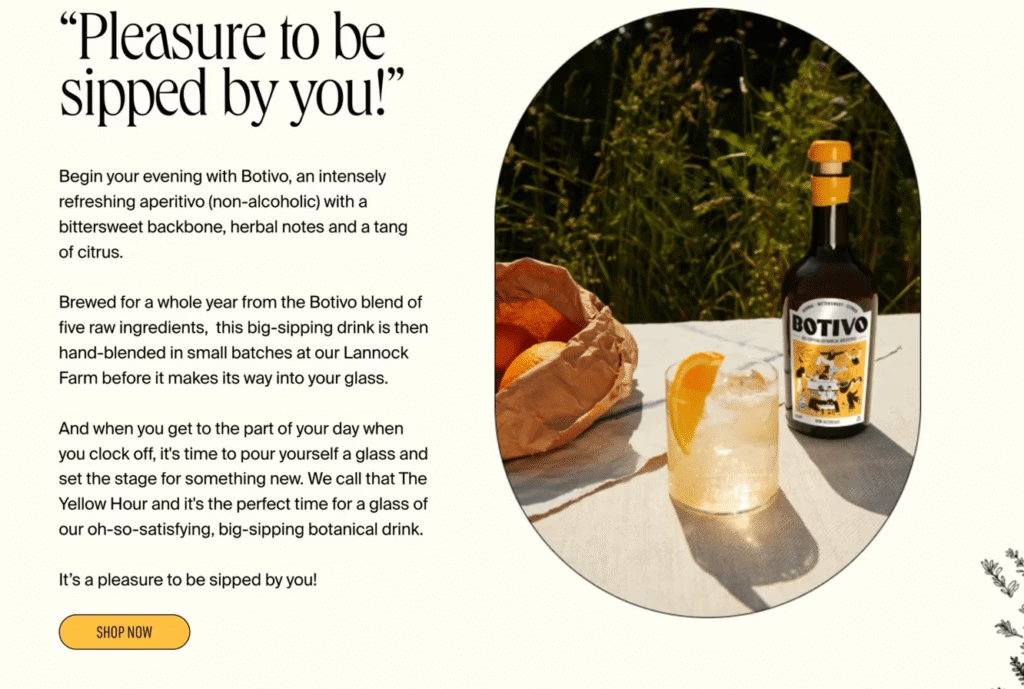
See how this mental movie is so much easier to follow? (It also neatly lines up with the brand video that plays in their hero section. Happy accident!)
Even better, this copy says all the same stuff as before. It’s not an overhaul or a huge 6-week project, just a few small tweaks that make a big difference.
See how in paragraph three we’ve moved that “part of your day when you clock off” to the beginning? By doing that, we put the reader in the scene and imagining it all before The Yellow Hour and the Botivo is even mentioned so they feel the experience of drinking a Botivo, they don’t just read about it.
Another tiny tweak was adding “before it makes its way into your glass” to the end of paragraph 2. We did that to give that sentence somewhere to go. Before, these sentences felt kinda floaty and detached from the story. They were just there to include information. Now, that same information feels like its part of the same narrative as all of the other lines.
And that’s pretty much all we did.
No massive rewrites or moments of genius. Just a few little tweaks that help make sure the copy is understood quicker and makes a stronger emotional connection with the reader.
And here’s the really interesting thing.
The sentences where Botivo wobbles are the kind of sentences where almost all brands wobble.
(They’re the sentences where we wobble on in our first drafts too.)
That’s because brand-first language is so easy to default to, especially when you’re trying to do a lot with one sentence.
Check this out and tell us it’s not oh-so-familiar:
Hand-crafted in Dorset by our experienced team of passionate experts, these award-winning, all-organic bars of soap…
To your founder, that sentence is going to get a hundred gold stars. It’s getting everything they want people to know about your brand into one sentence.
But the thing to remember is that while sentences like this can feel like you’re ticking all the boxes, you’re actually making it harder for customers to read and understand and relate to what you’re trying to say.
(That sentence in particular took 15 words before anybody could imagine the product in our heads.)
And that’s a big thing because, in 2023, a study found that when a brand is easy to process, customers automatically start to connect it to their own lives.
If your copy is easy to process and imagine, your customers’ brains begins linking your brand to their own memories and experiences, which creates a much stronger and more durable connection than general awareness of your brand.
It works because being easy to understand creates a sense of familiarity with your brand. That familiarity then triggers autobiographical thinking (“this feels like something I need in my life”) which then creates a genuine self-brand connection.
In other words: it helps create that “this is the brand for me” gut-feeling that’s super valuable not just for brand growth, but for customer retention too. Result!
🚨 Nuance time!
Now, there’s a time when the word-soup kind of copy (like our line about Dorset soap) works better than the narrative, mind movie approach…
… and that’s when you’re writing copy that people are going to skim rather than read.
We all know that people skim product pages and pick up keywords and ideas rather than reading full sentences.
That means that for copy that is going to get skimmed (bullet-points, product descriptions, h2s, etc…) then narrative and that mental movie is less important. Your goal there is to make sure that “award-winning” gets noticed and remembered.
But if you’re writing copy that is going to get read (emails, packaging inserts, homepage copy, social media posts…) then that’s when this filmic approach is going to make a big difference.
So, we guess, our point isn’t: write everything like a story. Not at all.
Just to be mindful of when you’re defaulting to that very ecomm-coded, word-soup-y way of writing without realising. And then make sure you’re doing it on purpose rather than out of habit.
(AI is really guilty of defaulting to writing like this too. Something to watch out for.)
So next time you’re staring at a piece of copy that’s not quite landing, try playing the movie in your head as you read it back.
Can you see all the details and the narrative clearly? Is there a clear sense of chronology that pulls you through the sentence and evokes a feeling?
Or are the sentences that are asking you to fill in the blanks? To make your own connections between ideas or work really hard to picture what they’re describing?
If it’s the latter, don’t panic.
You probably won’t even need to do a big rewrite. Most of the time, like with Botivo, all it takes is going back and stitching everything together as a coherent story.
TLDR: just try to make your sentences read like little mini movies and they’ll make it so much easier for your customers to connect with what you’re saying.