Steal our three-word trick to massively improve your product descriptions
Struggling to balance feature-rich copy with benefit-led storytelling? Find out how we do it with real examples from brands smashing it.

We’re taking a break from breaking down specific brands this week to give you a super-quick trick that makes a huge difference to your product descriptions and that solves one of the trickiest knots that every brand runs into at some point.
Stop us if you’ve heard this one before…
“OK, so we definitely need our copy to appeal to customers new to space and that might not know our brand, but we also don’t want to put off our core audience that are just looking to land on the page, find the info they need with no fluff and checkout. So we need copy that speaks to both audiences, ideally. Can we do that?”
That question used to make us feel a bit like this 👇
But after spending the better part of our early careers trying to Frankenstein and hodgepodge together some bits of feature copy and some bits of benefit copy, we realised that there was a neat little way to do both.
And best of all, all it needed was a neat 3-part sentence structure, a three-word bridge and boom!
Let’s get into it 👇
💡 This week’s big idea: sometimes, you can lead with a feature not a benefit if you also add “so you can”.
A few weeks ago, we talked about how the phrase “benefits not features” only paints half the picture and that you needed to really dig to find the benefits that resonates.
That’s 100% the case.
But there’s a bit more to it than that too. (Which we cut out because it made the email really long.)
Because there are also times when the conventional “benefits not features” advice just doesn’t apply and you should lead with features.
For example:
👉 When you’re selling a product that you know customers are thinking about very logically (like-for-like shopping, feature comparisons, etc…)
👉 When you’re selling a product to customers that are very category or product aware
👉 When your audience isn’t one audience at all, but a mix of customers across the stages of awareness all landing on the same page
👉 When your product has a technical side that properly matters (and that skipping would make you look vague or fluffy)
All of those situations are proven to require differing degrees of leading with the features.
Why? Because your customers aren’t all shopping the same way at all.
In fact, decades of research shows that prior knowledge of your product or category fundamentally changes how people process information about your product and make buying decisions.
TLDR: studies show that the more category knowledge customers have, the more they rely on specs and features over benefits.
Put another way, some customers are scanning for specs to validate a decision to buy your product, while others are searching for language that helps them imagine using it before they start to justify and validate and buy.
Which raises the question: if they’re both at completely different stages of the funnel, how do you speak to both on the same PDP?
Here’s how we do it 👇
A sentence structure that appeals to all of your customers’ brains
Balancing on that tightrope between completely different audiences is one of the trickiest situations that you’re likely to face when writing copy for your brand.
You’re basically being asked to do this 👇

Even more annoyingly, it’s not a problem that only affects technical brands or technology or utilitarian products either.
In fact, we see this most in brands when they hit that inflection point from launching to scaling. (AKA, where you need to appeal to more than just your hardcore audience and Day One fans.)
Let’s say you’re scaling your new craft beer brand.
You know you need to write some copy that appeals to both new drinkers and hardcore craft beer drinkers alike.
The problem is, to your existing audience, the term Amarillo conjures images of hops with tropical flavours and citrus notes.
To your new, broader audience, it leaves them thinking of Peter Kay marching to Tony Christie’s dulcet tones.
Which means you either stick with feature-heavy lines that appeal to your Day Ones and most-aware buyers like this 👇
A juicy banger that’s been late dry-hopped with Amarillo and a pale malt base. 6.0% ABV. Citrus-forward profile.
… or switch to benefit-led lines like this that appeal to new audiences 👇
This IPA is basically sunshine-in-a-can. Juicy, bright, beachy. The kind of beer that makes you feel like you’re on a beach in the Caribbean, even if you’re on your sofa bingeing Below Deck.
Whichever direction you go, you’re risking not talkin to a huge chunk of your audience.
And that’s exactly where we like to whip out this handy sentence structure:
Show the feature -> say what it does -> show the result for the customer.
You put that into play and suddenly, you end up with a sentence like this:
Amarillo hops added silly-late in the process and a pale malt base give you a juicy banger of an IPA with notes of ripe orange, mango pops and a hit of lime zest on the nose so you can crack open a 6.0%-er that feels like you’re on a beach in the Caribbean, even if you’re only on your sofa bingeing Below Deck.
See what a difference that makes?
Sure, we’ve added a touch of voice and personality here and there, but the structure it’s built around means we’re able to speak to both audiences at the same time.
We open with talking about the hops and the base (that appeals to category-aware buyers that scan for details), then we explain why that feature matters and paint a tactile, concrete picture of what enjoying the beer feels like for the customer (so that it appeals to the new customers that don’t know all the lingo yet).
Here’s why it works👇
1. It speaks to both audiences at once.
Research shows us that different customer profiles are looking for different things from your messaging and copy. Some prefer straight facts, some prefer to imagine using the product first.
On top of that, Cognitive Fit Theory tells us that people process information better when the format matches the way they’re approaching their task.
Put together, it follows that benefit-led readers shouldn’t have to translate specs into meaning, and spec-seekers shouldn’t wade through benefits when they want facts.
The three-word bridge “so you can” neatly lets you speak to both: it keeps the feature/why for comparison shoppers and adds a concrete payoff that supports mental imagery and intent. (All of which are tied to increased purchase intent for different shopper types.)
2. It becomes a teaching moment that builds trust
According to Self-Determination Theory, there are three psychological needs that drive motivation (and, by extension, intention to purchase): autonomy, relatedness, and competence.
Most brands nail the first two.
Autonomy: you can pick colours, flavours, subscription cadence, delivery speed, etc…
Relatedness: lots of lifestyle shots and “people like you” imagery and copy that talks about how the product benefits your life.
But competence, AKA that feeling of “I get this” or “I can do this”, is a much quieter and subtler box that only some brands remember to tick.
But empowering customers to make a decision is why educational content and UGC performs so well for first-time or category-creating products.
When a product doesn’t yet fit into a customer’s mental model — like a mushroom-based mood drink that you’re not sure how to drink or how to prepare or even what it tastes like — the customer needs to feel like they understand the product before they feel ready to even think about buying it.
That’s why Spacegoods make their “How to use” section the first thing you see when you scroll 👇
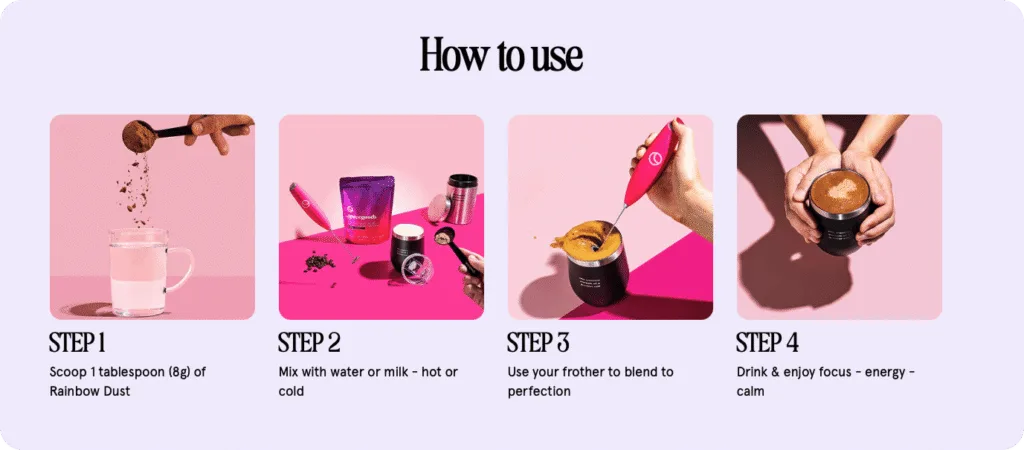
But competence goes deeper than “I know how to use this” and into “I understand this now.”
And when a brand explains why the features make the whole product work — or help explain what makes it different — they’re inviting the customer into that inner circle of understanding.
That’s where a sprinkling of Social Identity Theory comes into play too. You can use that teaching moment to also create a moment where you invite customers to start to think, “Oh yeah, I’m someone who gets this now.”
And, as we’ve discussed before when we looked at Huel’s copywriting, that’s super powerful for sales and for brand-building and customer loyalty.
Not to mention, studies consistently show that brands that help customers feel competent see greater satisfaction, trust, and loyalty.
🧠 Educating your customers like this also drives word of mouth referrals.
Studies have found that educating customers about your products creates a “significantly higher intention” of referring your product via word of mouth.
Why? Well, just think about how you recommend products to friends or justify an expense to yourself or your partner.
You’d probably say something like ” Oh, have you tried this product? It has this feature which does this and another feature that does that. I love it. It lets me do X, Y and Z.”
But to get to the stage where you really feel like you can stand behind the product and recommend it to people, you need to go through that gentle education. You need to understand the why behind the features. You need to feel like you’re on the inside of their audience.
And that’s why this structure is such a neat little trick.
(It’s also why Bold Bean Co help educate their audience on the difference between shop beans and gourmet beans.)
3. It creates a mental picture that makes customers more likely to buy
The moment you write copy like “so you can stay dry on the trail,” or “so you can wake up to softer skin,” you’re cueing the brain to imagine the outcome. (We talked about this when we looked at Honest Mobile’s ads before.)
That’s what psychologists call mental simulation and it’s been consistently shown that when people imagine performing an action or experiencing an action, the same neural pathways fire as if it was actually happening to them. That makes us more likely to actually hit buy now and checkout.
Studies have repeatedly found that mental simulation boosts purchase intent, confidence, and satisfaction after purchase. This is because customers already feel like they already know what it looks and feels like to use the product, which lowers risk and increases follow-through.
☝️ That’s the power of that three-word “so you can” bridge. It nudges the customer to start imagining using the product themselves. And once they’ve done that, you’re cooking with gas.
And it’s not just theory. Lots of big brands use it everywhere they need to talk about features…
We wish we could say we’d invented this technique. We didn’t. We just kind of stumbled on it one day.
But then we started spotting it everywhere, like the answer had been staring us in the faces all along.
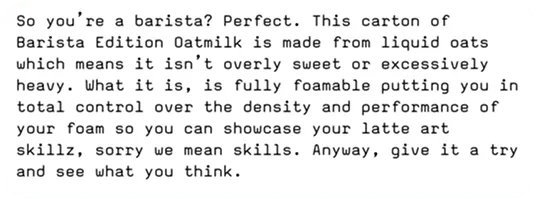
Here’s Oatly doing it on their PDP 👇
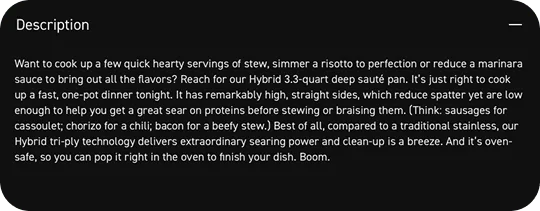
And here’s Hexclad doing it twice in one product description👇
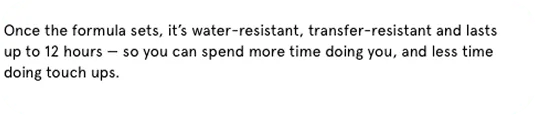
And here’s Glossier doing it 👇
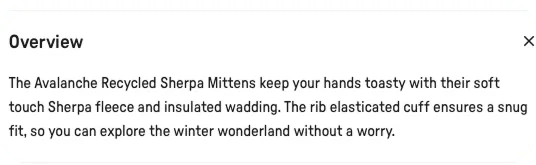
And Passenger 👇
… we found dozens and dozens more from every brand from Finisterre to Beavertown and back again, but you get the point.
And every single one uses the same underlying cognitive structure:
Show a feature → tell us why it matters → Show us what it does for us
That’s all there is to it.
It’s not a big, sexy copywriting technique, but it’s absolutely a bit of a game-changer for making sure every little bit of copy is working as hard as it can.
Where can you use this for your brand?
The real beauty of this trick is you can pretty much use it anywhere. It’s a real Swiss Army knife of a technique: it makes almost every touchpoint a little clearer, a little more compelling, and a little more likely to convert for every audience.
1. We 💛 using it on PDPs in subheads and product descriptions
Your PDP is the most obvious home for this kind of sentence as it lets you write big, brand-building headlines that appeal to the new customers without losing your persuasiveness for the repeat and more aware buyers.
In fact, you can use it right in your hero copy. Open with a big, benefit-led h1 and then dig into the feature, reason and benefit in the subcopy, like this 👇
Wake up glowy, not greasy.
Our ultra-hydrating retinal serum releases slowly overnight so you can wake up to softer, smoother skin and not a splodgy pillowcase.
Then, as you move down the page a little, we like to use it in product description bullets too. Like this👇
- Encapsulated retinal gently boosts cell turnover through the night, so you can get the smoothing power of retinol without the redness or flaking.
- Niacinamide and ceramides strengthen your skin barrier while locking in moisture, so you can wake up calm, dewy, and very rightly smug about your bedtime routine.
[Feature] → [benefit of the feature] → [so you can do X]. Scanners see the details that matter to them, less-aware buyers get all the benefits and the feel goods. Simple and effective.
👋 Pro tip: Your bullet-pointed product descriptions on your PDP are absolutely tailor-made for this technique. Those bullet points have a tough job: they need to communicate a lot of information, very quickly, to very different types of readers without being boring, dry or losing the sale.
In fact, according to Baymard Institute’s 2024 benchmarks, these feature bullets are one of the most-scanned sections on any PDP. Customers skim them before deciding whether to scroll further or bounce.
And that’s exactly where the feature → why → so you can sentence structure comes into its own. It compresses features, education and benefits into the same breath so they’re compelling, super-skimmable and primed to give all customers the information they need to hit that “buy now” button.
2. On annotated images and “what’s in the box” sections
We all know that on bigger ticket items (or anything that isn’t a quick impulse purchase), customers can get a little Timmy Chalamet in Dune…
So it’s no surprise that Baymard studies show that featuring a “what’s in the box” section helps to improve customer confidence, purchase intent and reduces returns. Result.
Which makes this a perfect place to not just list the features, but educate the customer a little bit too.
A bit like this from Allbirds 👇
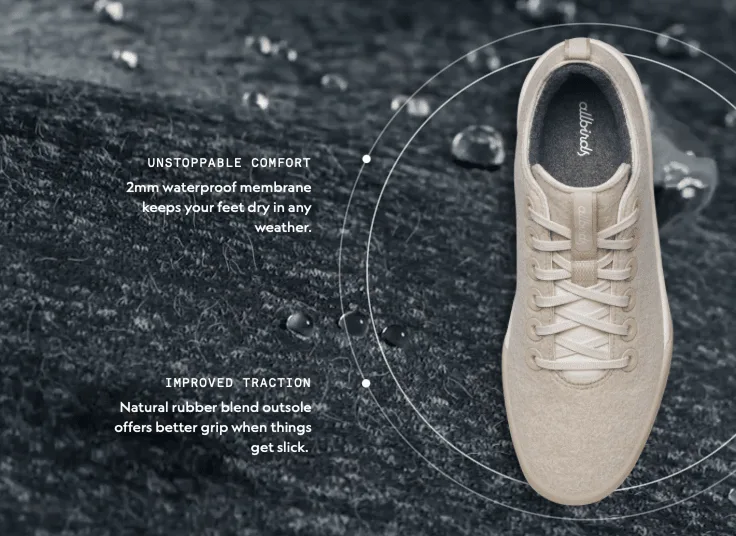
Here, you’re not just making the product feel more premium and better value for money, you’re helping your customers feel more competent and confident clicking that “buy now” button because they understand why they need that feature.
(note: Allbirds shuffle around the structure to tell us why it matters → name the feature that does it → Show us what it does for us, but all the ingredients are still there and it ticks all the same boxes.)
3. In your emails, ads and on social media
Short copy is where the structure really comes into its own.
When you’re on a tight deadline and you’ve only got space for a sentence or two to really sell the product, back it up, make it feel human and speak to an audience of customers across the stages of awareness, you can do a lot worse than something like this 👇
“Smudge-proof mascara that lasts for 12 hours so you can finally watch the end of Coco without needing to wash your face.”
Just name your big feature or USP, explain why it matters, wrap it up with a “so you can” section then sprinkle a little bit of voice and novelty in there to make it memorable? Add into your A/B testing and see how it does!
👋 Pro tip: this structure doesn’t even have to see light of day in the final copy if you don’t want it to. Sometimes, we’ll use it as our go-to in a first draft to make sure we’re being super clear on adding proof, benefits, making it tangible, etc… then we’ll shuffle it about, add it in different places, etc…