
💡 This week’s big idea: AI not “getting” your brand voice isn’t really an AI problem at all. It’s a brand voice document problem.
Whenever we talk to brands about their AI copy and their voice, we usually hear the same phrases cropping up again and again:
“It sounds good, it just doesn’t sound like us.”
“I spend hours training it on our voice and it still just doesn’t get it.”
“I’ve tried all the prompts, I’ve got a custom set up and it still finds a way to write like AI, not our brand.”
Add to that all of the “sea of sameness” stuff that we talked about before, the rise of category copy over brand copy, the decrease in brands that feel like they have a strong voice…
And it starts to feel like this is all happening because of AI.
But, having been nerding out about brand voice for the better part of a decade and a half, we’re pretty sure that AI is just doubling down on something that was already happening.
Because, even before AI arrived, brands were slowly losing their originality and distinctiveness.
And there are a couple of reasons why, we think.
Firstly, it’s never been easier to launch a brand. Shopify, social media, print-on-demand, dropshipping… the barriers to starting a business disappeared over the last fifteen years. Which is incredible. But it also means more brands and more competition and more crowded markets.
And those increasingly crowded markets create more pressure to focus on the things that drive immediate revenue, not long-term plays.
As a result of that, copy became less about positioning and brand-building and more like CRO, chasing a percentage bump in week over week performance over things like getting remembered or even trusted.
(But, as Peter Field said, “Digital has spent a decade telling us you can measure everything instantly and that it’s a good thing. The reality is it’s a very bad thing.”)
Then you factor in the fact that, before AI copy blew up, 44% of copywriters and brand managers said that rewriting copy for tone was their biggest time-suck.
Which means that you’ve got a tinder box of brands that got squeezed into focusing on performance over brand and struggling to keep their voice consistent and distinct before this big, existential shift to the way we write copy happens.
It’s a perfect storm.
In fact, in 2025 researchers published a paper called Galton’s Law of Mediocrity which says that when AI generates copy, it basically guts things that make it unique.
Emotional texture. Real-life experiences. Unusual turns of phrase. Metaphors. Humour… all those specific things that make up a brand voice are actively eroded by AI unless you specifically tell it not to.
Which brings us onto the importance of a good brand voice document.
Now, if you’ve read the article we wrote last year on how to document your brand voice, you’ll know that a good brand voice document isn’t easy to find.
But the even more uncomfortable truth is, even the best brand voice documents don’t really work when you give them to AI.
Before AI took over the world, we helped brands of all sizes (from 5 people to 500+) document their voice and how they communicate.
And we spent years refining our process and approach so the final docs were written in a way that made sure that even Bob in Accounting (who mostly sends 👍 in Slack) could write in the brand’s voice if he needed to.
We magpie-ed the best bits from the hundreds of documents we’ve read, added and invented new sections, tested with non-writers and then combined it all into a properly robust brand voice document that we thought was the creme de la creme of brand voice documents.
So when AI started blowing up, we thought all we’d need to do is upload one of our brand voice docs and the wobbles would sort themselves out.
We couldn’t have been more wrong.
The results weren’t awful.
But they definitely weren’t right.
And that’s because brand voice documents written for humans are designed to let humans paper over the cracks.
The absolute best brand voice documents for humans assume they’ve got a lifetime of sorting good copy from bad copy in their heads.
You can assume that they have taste. You can assume they know the brand inside out. You can assume that they know when the vibe of a piece just isn’t right.
Which means the document you put together can leave things a little open to human interpretation and you end up with much better copy as a result. (Because the good stuff comes from giving a talented writer a framework to write from, not a straitjacket that gives them no creative license.)
But the wiggle room that makes a document great for people is what makes it a problem for AI.
That deliberate vagueness and room for creativity gives the AI permission to default back to that middle of the road blandness you’re fighting against.
And this was a lesson we had to learn the hard way.
So we thought that rather than just saying “human brand voice docs bad”, we’d take a gold-star brand voice document, give it to AI and show you how even the best brand voice docs aren’t made for AI.
Let’s get into it 👇
Can AI match Monzo’s brand voice from their tone of voice documents?
Monzo’s tone of voice guidelines are pretty much THE document everyone thinks of when you talk brand voice guidelines.
And for good reason. They changed how a lot of people think about brand voice.
Before it, there were brands that got praised for their voice (your Innocents, your Lushes, your Virgins…) but the conversation was always about the output, not the thinking.
Monzo changed that.
They made their tone of voice document public and showed people why they write the way they do and the thinking behind it.
And for a lot of non-copywriters, these guidelines were the first properly in-depth voice guidelines they’d seen. It wasn’t just three voice pillars and a mission statement. It was properly in-depth. There was the thinking behind it. There were examples of right and wrong copy so you could learn from seeing, not just reading.
(And they’ve continued to update them over the years too, which is huge. Because voices evolve and change as brands change.)
As you might have guessed, we’re big fans.
We mean, check this out 👇
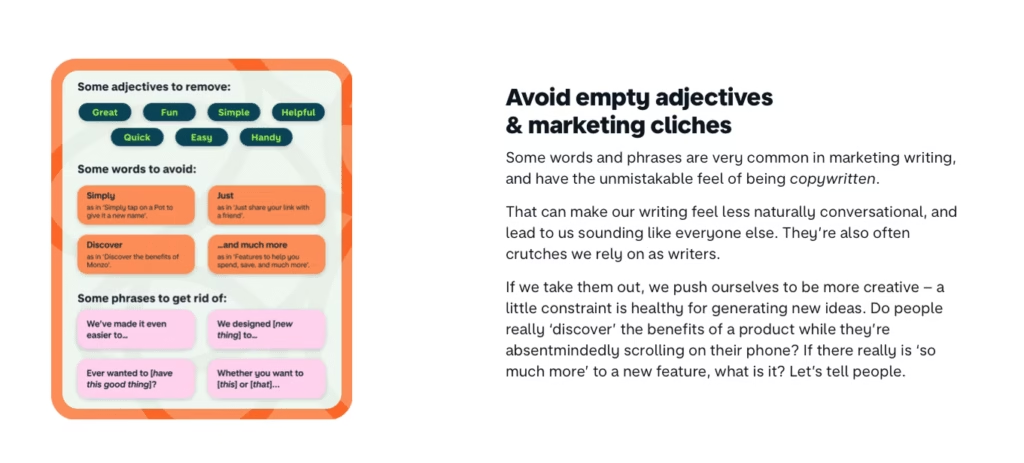
Now, are there things we’d do differently if we were to be asked to rewrite it for them? Yeah.
But that first version Monzo published in 2018 was so foundational to how we think about brand voice guidelines that it’s a bit of a trick question.
(Because we can confidently say we wouldn’t be half as good at writing brand voice documents if we hadn’t read Monzo’s when it first came out.)
So, we thought it’d be a good idea to take a (publicly available) brand voice document that is held up as one of the best in the game and see how well AI can use it.
First, we had to find the perfect bit of Monzo copy to use as a control
To test this idea properly, we knew we needed to find a piece of copy that Monzo had written and compare it to what AI gives us.
And we had to make sure this was a fair fight, so:
👉 It couldn’t be something nuanced and that required a lot of context to write.
👉 It had to be a self-contained brief that was relatively straightforward, like a single feature or a single product. Basically, we wanted to make sure that the only place for AI to fail was to write in the wrong voice, not get the details wrong.
👉 It had to be something that used all three of Monzo’s brand voice principles: straightforward kindness, everyday magic, warm wit.
👉 It had to be short enough that AI couldn’t paper its cracks. (We’ve noticed if you ask AI to write longer copy, it can sometimes stumble on the voice here and there, but in shorter copy it can’t fluke it so much. So we wanted to avoid that false positive.)
👉 It couldn’t be a big, loud H1 because AI handles those pretty well. The real test was asking it to modulate the brand voice (AKA knowing when to dial the voice up, when to pull it back, when a plain sentence is the right choice over a joke, etc…)
Those last two were big ones, because we’d wager that 99% of the copy you actually use AI for aren’t big OOH-style headlines or long, 5-paragraph bits of copy but are PDP copy, emails, social captions, little tweaks… and that’s almost always short and toned down copy.
So this is the bit of copy we landed on using as our control piece 👇
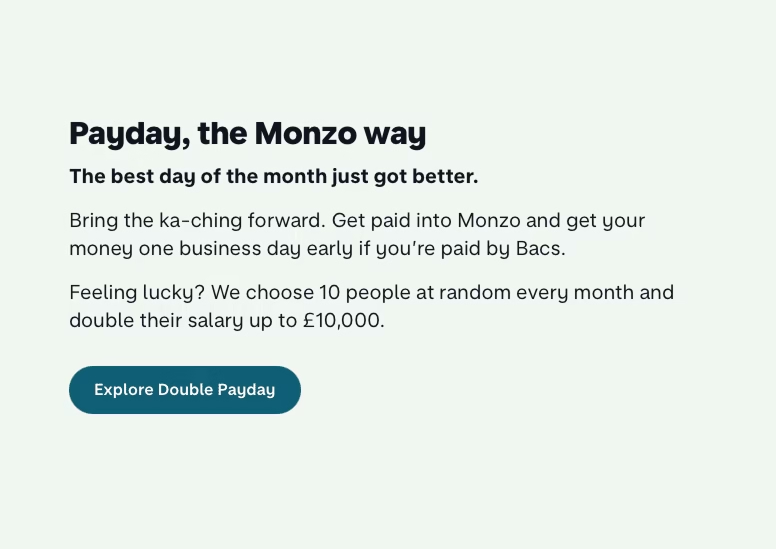
First of all, it’s a really good example of the Monzo voice. Not big and showy and not in-your-face informal and chatty. Just right. That ka-ching is a fantastic touch too.
(That’s exactly what they mean by everyday magic. Their writing has to have a little detail that’s there to make the customer smile or feel delighted otherwise it isn’t Monzo.)
Not only that, but it also doesn’t feel like the kind of copy AI shouldn’t be able to replicate, right? Especially if it has almost 2.5K words of guidelines and examples to draw on?
Let’s see.
AI’s attempt at replicating Monzo’s brand voice
We gave Claude this brief:
Write a short piece of web copy for Monzo’s Get Paid Early feature. Customers who get paid by Bacs can receive their salary one business day early if they use Monzo. There’s also a Double Payday promotion where 10 customers per month win double their salary up to £10,000. Use the Monzo tone of voice document.
We also gave it their full brand voice document, too.
And this is what we got back 👇
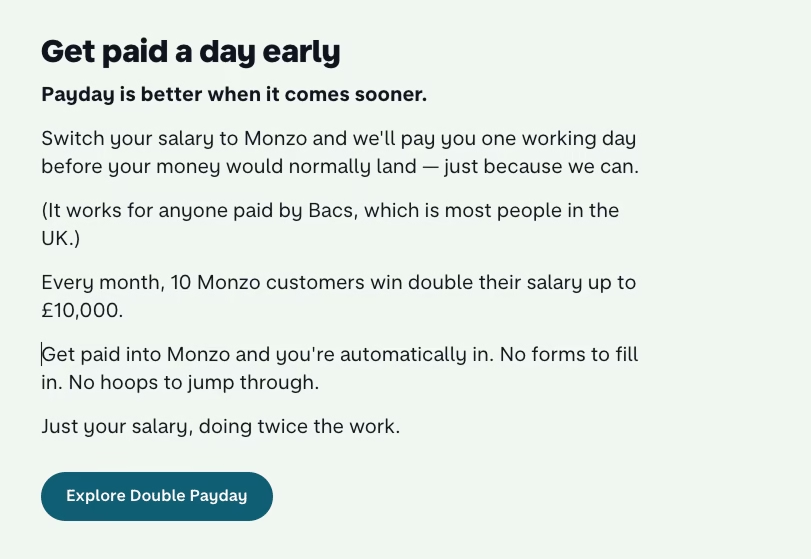
We mean, the copy is fine. It’s not egregiously bad in any way.
Sure, it’s a bit inelegant in the way it switches between the early payday and the £10,000 salary doubling, but that’s an easy fix.
And it’s done a good job of adapting to the simplicity of Monzo’s language and being straightforwardly kind. You can see it’s going for empathy and to make things feel as easy as possible.
(With the exception of “just because we can”. That’s that sales letter philosophy leaking back in.)
But you’d be hard-pushed to say it has anything that feels close to warm wit or everyday magic.
There’s no surprise or delight in the language at all.
No unexpected details or phrases designed to get a smile or any phrasing that feels particularly witty.
Which means that it hasn’t written in Monzo’s voice, despite having a huge and well-respected brand voice document to work from.
Another interesting thing to note is that Monzo has been around since 2015. And a lot of stuff has been written about their voice on the internet. Which means that there’s also probably a lot more information about them in AI’s training data that it could pull from, too.
Editor’s note: We asked Claude about this and it said “The copy was built purely from the tone of voice doc plus what I already know about Monzo from training data (which covers them reasonably well given how publicly they’ve talked about their product and brand).”
In other words, it had more context on their brand, positioning, customers, etc… than the tone of voice document we gave it.
(And probably a lot more context than it has on your brand, unless you’re already pretty massive.)
And yet, even with all of that, it still came back with something that loses that distinct Monzo-y-ness of the language.
It’s the kind of generic, wallpaper copy that everyone gets from AI.
And that’s the big problem with giving AI a brand voice document that was written for humans: the voice of it all is left completely open to human interpretation.
And that means that we’re making it really difficult for AI to ever properly “get it”.
🧠 Most brand voice documents were written for a world where humans did all of the writing.
Monzo’s tone of voice document (like the best brand voice guidelines for humans) is as much about training and calibrating the writer’s instincts as a writer as it is about showing them how to sentence-by-sentence.
And as a human writing the copy, that’s an absolute dream.
You’ve got a bit of creative freedom, you can trust your gut, you can find your own way into the Monzo voice… all while staying on brand.
And for massive organisations with lots of people writing for them, that flexibility works far better than rigid rules and 15-point voice checklists everyone needs to follow.
But for AI, it’s permission to regress to that beige, generic voice you see everywhere.
Look at almost any line in Monzo’s tone of voice document and you’ll notice the same thing: it’s almost always rooted in human experience or taste or judgement.
Humour is a delicate seasoning. (What kind of humour? And what does a delicate seasoning look like in practice?)
We can be funny, rather than that we have to be funny. (How do you tell between the two?)
We handle deeper emotions with care. (How do we handle with care? And what constitutes a deep emotion? Do we handle joy with care?)
We avoid the obvious to keep things fresh. (What is too obvious for the Monzo audience?)
☝️ All of that stuff relies on a seasoned writer and human with lived experiences reading between the lines and filtering their own taste and judgement to get the Monzo voice bang on.
But AI doesn’t have any of that to pull from.
Which is probably why the wit and everyday magic parts of the voice were missing from its attempt to sound like Monzo. You’re asking AI to do something it just can’t do without you giving it waaaaay more context.
(Note: in fairness, some of Monzo’s more granular voice tips are great. There’s word swaps and how to choose words and notes on how to adapt the voice for different channels which are all really well done. They’re all great for AI. But they’re the surface level stuff, without the big picture stuff, it all gets a bit messy.)
How to put this to work for your brand
Now, usually, we like to end these emails with something practical you can take away and put to use.
But the more we tried, the more we realised that this one’s probably too chunky to solve in a single email.
So instead of a half-baked fix, here’s the most useful single change you can put to work straight away 👇
If you have a brand voice document, how much of it is reliant on a human understanding subtext? Or a human having taste? Or a human using their lived experience to fill in the blanks?
If you don’t have a brand voice document, how much of your tone prompt is guilty of the same? How much of your prompt is about vibe rather than details and guidelines?
Because to a human phrases like “everyday magic” make sense. We instinctively know what that means and what a sentence like that looks like, even if we can’t put it into words.
But to AI, it has so many different interpretations that it’s almost meaningless.
It has no lived experience to pull on. And it doesn’t have that gut feeling of “aha, that line is so Monzo” that a human writer would get.
So for this week, try making your AI prompts more tangible and practical.
Think about it like this:
Don’t say your voice needs some “Everyday magic” like you would a human writer. Say something like this instead 👇
When writing copy for Monzo, include one moment of unexpected delight per piece.
This should be a word choice, phrase or detail that makes the reader smile or feel seen. Not a forced joke and not a pun. And definitely not a reference to magic.
Getting it right looks like making the reader feel something, not just like they’re reading information. “Get paid a day early” conveys information. “Bring the ka-ching forward” makes them feel excited and conveys the same information. We aim for the second.
Aim for one moment of delight per piece, not one per sentence. Never a pun, especially not an obvious one. Never use the words magic, delight, or sparkle as they’re too on-the-nose.
☝️See how that gives AI much clearer, less subjective instructions? How it avoids prompting based in lived experience? And it has an example of right and wrong copy and rules on what not to do?
That’s the kind of specificity in a brand voice doc that AI can use.
(We asked Claude to write the copy again with this information and it gave us “Turns out payday is more of a Thursday person”. Much closer. Not quite “bring the ka-ching forward” but much, much closer.)
Over the next few weeks we’ll dig into the nitty-gritty of the changes and adaptations we’ve made to brand voice documents that make them work for both humans and AI.
But even before that, if you adapt your prompts so they’re closer to the Monzo one we wrote, you should notice a difference in the copy you get back straight away.
And if you don’t, just hit reply and tell us what prompts you’re using. We’re happy to take a look and give you some pointers.
If this is ringing a few bells (whether you’ve got a document that might be guilty of this, or you haven’t got one at all yet) this is exactly what we’re here to help with.
We’ll document your voice in a way AI and your team (even yellow thumb-emoji Bob) can actually use, build you a custom copybot around it, and leave you with something that feels less like prompt-in-copy-out and more like you’ve cloned a really good copywriter, trained them on your brand and then trapped them inside your keyboard.
If you want to see what that looks like for your brand, grab 30 mins on our calendar and we’ll run you through the whole thing, from the brand voice documentation all the way through to seeing the chatbots in action.