We all know that boring, lifeless copy doesn’t sell.
As David Ogilvy — the copywriter who puts the OG in Ogilvy advertising agency — once said, “you can’t bore somebody into buying your product, you can only interest them.”
And in the past, we’ve talked about loads of tips and tricks for everything from writing product descriptions to hero sections to microcopy that grab attention and sell more stuff.
But when it comes to humour—one of the most effective ways to make your brand unforgettable—things get tricky.
Why? Because humour is subjective. What absolutely cracks one person up might get an eyeroll from another.
But it goes deeper than just what we find funny too.
Comedy is always about power dynamics. Who is the butt of the joke? Who is making the joke? How well do those things mesh?
And regardless of your sense of humour, there’s one golden rule of funny copy that works across the board. And it’s been true since Ancient Rome: punch up, not down.
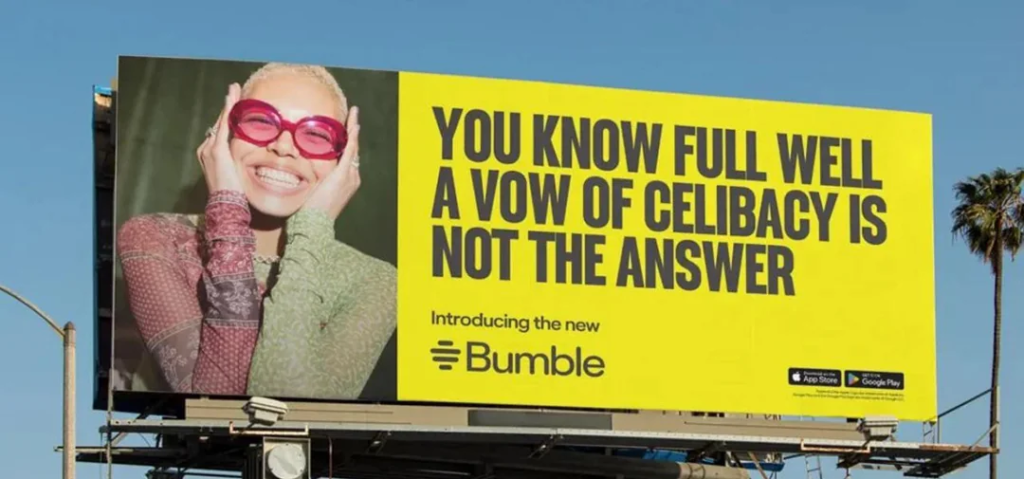
And that is why this ad from Bumble got so much backlash 👇
Punching up: the key to funny copy
Punching up is a golden rule for writing funny copy that dates back all the way to the Roman poet Juvenal : he said that humour is only funny when it “punches up” or takes aim at people in positions of power.
👉 It’s funny to joke about your boss around the coffee machine.
👉It’s funny to roast a president or a mega-corporation.
👉 It’s not funny to make fun of the intern, a struggling customer, or people making choices about how they live their lives.
(Hey Ricky Gervais 👋 You might wanna take notes.)
And as a brand, these invisible power dynamics matter a lot. Why? Because humour that punches up builds trust and brand loyalty, while humour that punches down erodes it and makes your brand look bad.
(Look at Bumble undoing years of work to empower women’s choices with this one ad.)
💡 Remember, jesters made fun of kings, not paupers. Always make the butt of the joke something bigger than you.
How humour in copy builds connection (according to science)
Being funny in your copy isn’t just about grabbing eye-balls and getting laughs. Study after study shows that it’s a shortcut to creating lasting relationships with your customers 👇
👉 Sharing a joke builds trust in your brand
Did you know that studies found when we share a joke with somebody — whether a person or a brand — it helps us feel psychologically safe and leads to stronger connections? But on the flip side, aggressive or divisive humour alienates people and makes them trust you less (because ultimately, they could be the victim of your next joke) according to the Marketing Science Institute.
👉 A little bit of self-deprecation works wonders
Making your brand the butt of the joke sends proper humility and relatability signals that your customers love. Harvard Business School actually notes that joking about your imperfections is a great way to humanise your brand and invite your audience to connect with you on a deeper level.
👉 Shared jokes create a sense of community
You know how your friendship group all shares in-jokes and has the same sense of humour? It’s the same for you and your customers. Having a shared sense of humour helps your customers feel more connected and aligned with your brand, according to a study published in Marketing Letters.
Funny copywriting is all about balancing those tricky power dynamics
The difference between good funny copy and bad “funny” copy is almost always an issue of power dynamics.
Are you punching up at somebody with more power over you? Or are you punching down at people with less power than you?
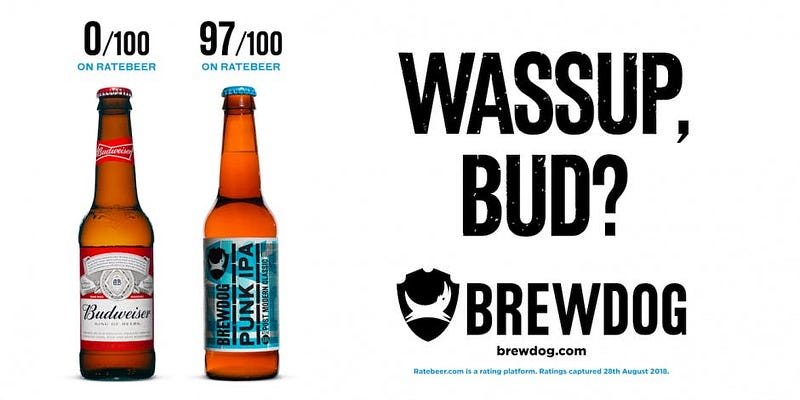
Ultimately, it’s that distinction that makes the difference between this great, attention-grabbing and on-brand billboard…
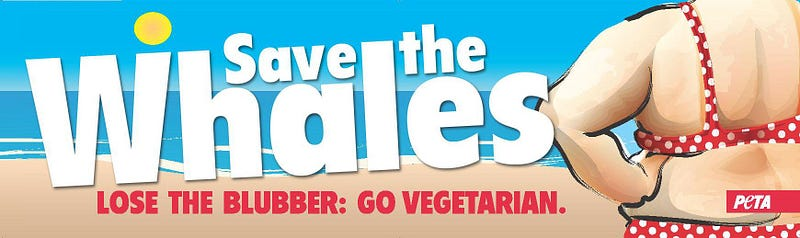
…and this ad that had us reaching for the eye-bleach 👇
As a brand, you’re in an unspoken position of power over your customers.
Consumer psychology says that the relationship between brands and consumers closely resembles interpersonal relationships, with your brand most likely playing the role of an authority figure or trusted advisor in their lives.
On top of that, your brand is in control of everything from the information that customers see to the price they pay to whether they can return products if they’re unhappy.
👆️ And that creates a wonky power dynamic.
So if you go full PETA and poke fun at your customers, you’re abusing that power dynamic. You’re not being funny, you’re just being a dick.
But if you go full Brewdog and punch up at something bigger and more powerful than you — in this case, the second most valuable beer brand in the world — then you don’t just get a laugh and grab attention. You get to plant your flag in the ground and show why you’re better than the Goliaths.
(For more on this flag-planting approach to calling out the competition, check out our Instagram post from last week.)
That said, you can poke fun at your customers if you do it right.
OK, here’s where things get complicated…
It would be very easy to say that you can never poke fun at your audience.
But the truth is, you can.
And when that works, it really works.
🧠 The science of joking around: gently roasting your audience (the right way) isn’t just about getting laughs—it’s about building a deeper connection with them. Studies show that playful teasing doesn’t just scream “we get you,” it also helps create a shared sense of identity. (AKA, the magic stuff that turns a regular ol’ customer into a loyal, shouting-your-praises-from-the-rooftops kind of customer.)
Here’s why it works: parasocial interactions (PSIs). 👈 That’s a fancy way of saying that customers can form one-sided relationships with brands and think of you as a buddy, not just a business.
And when you poke fun at them in a light and loving way, you’re not just making them laugh; you’re showing that you’re on their wavelength. And that shared understanding is pure brand loyalty magic.
In fact, a study by Labrecque (2014) found that brands who engage their audience in a personalized, human way (think: cheeky tweets, witty responses) build stronger bonds and even earn more loyalty than brands that keep things professional.
The problem is, nailing this is tricky to do.
So let’s look at three examples.
One that’s “what the hell were they thinking?” levels of bad.
One that comes so close and then gets it all wrong.
And then one that’s (eventually) really good.
We’ll then pick apart what you can learn from them and give you a few formulas for punching-up headlines that you can use for your brand.
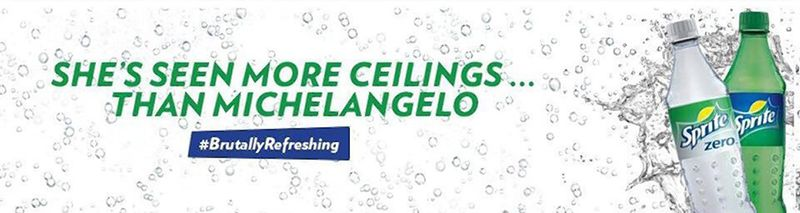
The Ugly: Sprite’s #BrutallyRefreshing campaign.
OK, let’s get started with these steaming hot sacks of shit from Sprite 👇
[Fair warning: these ads are bad. Like, lose your faith in humanity bad. Brace yourself.]
And this…
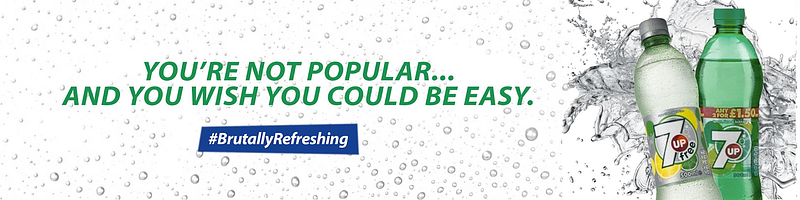
We mean, where to begin?
For the sake of not getting all Gloria Steinem on you for the next 1000 words, let’s ignore the absolutely heinous sexism and misogyny on display here.
Instead, let’s just assume that the intention of this campaign was to get Sprite trending and people talking about it.
(We guarantee “all publicity is good publicity” was said several times in the board meetings.)
Still, seriously, what the actual fuck?
Yes, people don’t really buy drinks like this based on copywriting alone. (As much as we might like to pretend otherwise.)
Yes, brand loyalty isn’t going to be particularly huge for carbonated lemon drinks.
And yes, this ad probably raised their visibility.
But still, we’re sure there was an idea out there that didn’t shit on their customers.
Maybe something had a hint of playfulness to it, rather than a godawful negging-ness to it, a bit like Snicker’s “You’re not you when you’re hungry” ads.
(You could even still rib your customers a little by saying something like “That folk-punk-hip hop album you’re working on? We wouldn’t quit our jobs just yet.”)
It’s really, really bad.
That said, most copy that punches down isn’t this egregious or overtly awful.
It’s subtler and done with a wink-wink tone that hides the ickiness.
Which brings us onto the second example 👇️
The Bad: Revolut’s TFL ad campaign
This is where things get interesting, because on the surface, this copy isn’t bad at all.
It’s attention-grabbing. It’s shareable. And it attempts to be relatable and speak to its customers.
The only problem is with the power dynamics. (And, as per, some good ol’ relics of old fashioned ideas.)
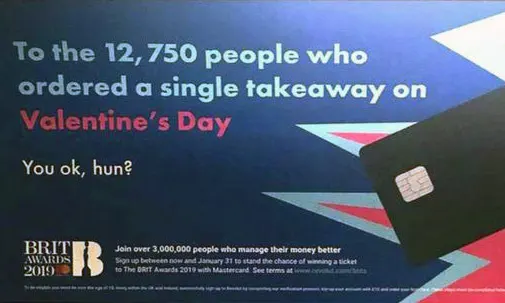
Let’s ignore the blatant ripping off of Spotify (more on those in a second) and the fact that they just pulled these stats out of their arse, the Revolut ad here probably made people laugh on the tube.
But who is the butt of the joke here? A single person eating alone on Valentine’s Day.
And why is that funny? Why is that something that their brand — in its position of power and influence — feels that all the people on the tube should laugh at? 🙄
In fact, it’s not even the Valentine’s Day thing that’s the problem.
It’s the “U OK, hun?” part.

In its attempt to connect with their audience, they went with some meme-y slang.
Again, great idea in a vacuum. But poor execution.
The problem isn’t with the meme-y language. It’s with the message.
The joke would still have worked 10x better if they’d gone with “We shared ours with our cat” or “Crank that Beyonce, sister!”
If they’d chosen to lift their customers up and created common ground rather than make fun of them, the ad would be much funnier. And still be relatable. And still primed to get shared on social media.
Plus! It would be without any of the pernicious, “let’s laugh at single people” vibes that are so wholly off-putting.
In fact, changing that three-word tagline would have made the difference between it being a stinker and an ad that says “we’re a bank that really gets you”.
The Good (eventually): Spotify’s Forever Alone ads
Now, let’s look at a Spotify ad that Revolut shamelessly cribbed 👇
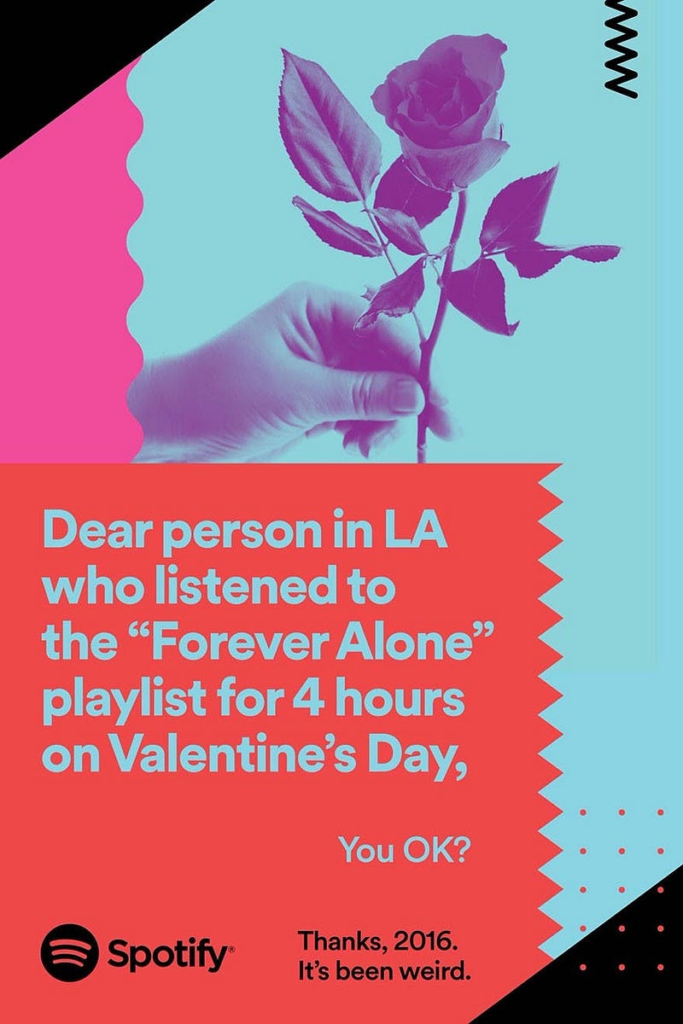
They’re almost the same ad, right?
(Spotify were very gracious about it by just saying “some of our favourite songs are cover versions, so who are we to judge?”)
However, there are a few key differences between Revolut’s ad and Spotify’s ad:
- This is about one person, not 12,750 of them. As such, it loses a lot of that nastiness. It’s not about laughing at anybody who is single.
- There’s no patronising language in the form of “hun”. That makes a huge difference.
- Your taste in music is nowhere near as private as what you spend your money on.
- It’s designed to be funny and relatable. It’s exaggerated and over the top, like a scene from Forgetting Sarah Marshall or Bridget Jones’ Diary.
But, let’s be honest: this Spotify ad isn’t perfect. It still punches down, no matter how well it hides it.
And Spotify, to their credit, realised that. This is the updated version 👇️
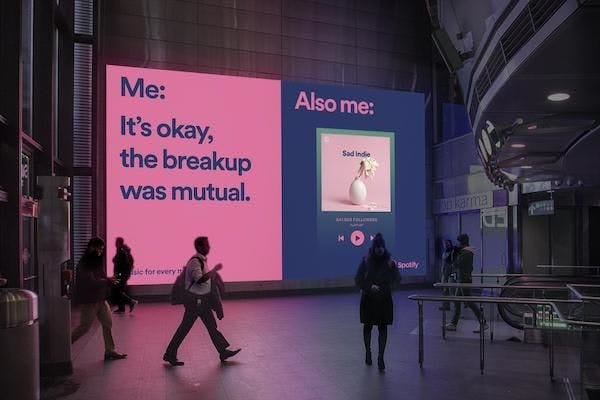
The joke and set up is identical.
But the butt of the joke isn’t the customer now, it’s the brand.
And when customers read this ad, they laugh at this fictional Spotify character.
It’s punching up at itself. The customers can laugh at Spotify and still feel like Spotify understands them. (This ad basically ticks all of those consumer science boxes.)
On the other hand, the Sprite and Revolut ads punch down and do more harm than good.
Channelling all the toxic energy of a high school bully, their copy is about making their customers feel bad OR getting their customers to laugh at other people.
The trick to this? Making sure your humour reflects the relationship you have with your customers. You want your customers to laugh with you, not feel laughed at.
Put this into action: how to make sure your jokes are punching up
Step 1: Nail down your relationship with your audience
The power dynamic between you and your customers — even if it’s not spoken — can make or break your funny copy, so make sure you really understand how your customers see your brand.
Ask yourself: do your customers see your brand as a friend or an authority?
Use this answer as your barometer of how much to joke around with them.
If your customers see you as an authority, make jokes about the bigger things (like competitor brands, big ideas, etc…). If your customers see you as an equal, make jokes about shared experiences.
Step 2: Who’s the butt of the joke?
Run every piece of funny copy through this filter: does this joke make our customers laugh with us or feel laughed at?
That doesn’t mean you can’t make fun of your customers. But it needs to be in a laughing at you and your audience way.
Look at how quickly Bumble’s ad could have been fixed 👇️
❌You know full well a vow of celibacy isn’t the answer.
Gross. Misogynistic. Just no.
✅Vow of celibacy? Respect. But we’ve got options, just in case.
Now, this isn’t perfect at all — the whole idea should have been thrown in the bin, tbh — but at least this doesn’t punch down. It respects individual choices and promotes Bumble as a brand that accepts and empowers everyone. (You know, the things they wanted to be known for.)
Step 3: If the joke feels off — even if it’s just a gut feeling — shift the target
We’re not expecting you to be expert-level comedy writers, so trust your gut.
If a joke feels even slightly off, make your own brand the butt of the joke instead.
For example, you can do something like this 👇
❌ Stop being a dum-dum that buys crappy supplements. Switch to ours instead.
✅ We could have bought a football club with the amount we wasted on crappy supplements. So we created our own. (Now we just waste that money on 2am Amazon sprees.)
Exactly the same message, but by switching the target of the joke from the audience to your brand, it works 10x better.
If you’re still not sure if it lands, get somebody else to read it.
We’re all guilty of being too close to our copy sometimes.
(The two of us are even more guilty of finding our own jokes hilarious.)
So if you can, get an outsider to read your copy. Do they laugh? Do they wince? Do they do a sensible chuckle?
And if you can’t get a second opinion, ask AI to read it and ask it if your copy punches up. (AI might not have the best sense of humour but it’s quite literally trained to not be offensive, so it’s got a good nose for this.)
3 funny copywriting formulas that pack a punch (and punch up) 🥊
👊 Pick an enemy that your brand and your customers have in common and call that out in a funny way
Just like your favourite fizzy drink, but — you know — not evil.
👊 Be relatable. Use the Us/Also us template (like in the Spotify ads).
Us: Get rid of those pre-publish jitters when you write your copy.
Also us: spends 6 hours fretting over every newsletter before we hit send.
(Definitely, 100% not autobiographical, that one.)
👊 Create an over-the-top analogy for your brand experience
Our sherpa-lined hoodies are like getting a warm hug from your Grandma, just without the overwhelming smell of lavender.
And whatever you do, don’t ever, ever, ever, eeever call your customers whales.