How copy can save the day when sh*t hits the fan over BFCM & Christmas
Site crashes? Broken discount codes? Here’s how copy can help you handle mess-ups and keep customers coming back for more.
It’s that time of year again where it feels like every email, LinkedIn post and IG reel is about Black Friday…
And while there’s definitely stuff we could say about making your copy better for this chaotic period, it’d likely be the same stuff we say every week…
Make your offer crystal clear. Speak to your customers. Make it obvious why they should buy. Make sure you stand out and grab attention…
And, if we’re 100% honest, during Black Friday, it’s pretty much all about your offer and your discounts that do the heavy lifting.
However, the area that your copy can really shine during the chaos isn’t when things are going right, it’s when they (inevitably) go wrong.
Like sending out broken links. Or incorrect discount codes. Or your site crashing just as you hit peak traffic.
(Quite fitting seeing as this email is dropping a bit late because half of the internet broke.)
Those things happen to brands all the time, but when the Q4 rush brings you a gaggle of new customers trying your brand for the first time, messing starts to feel like “crap, never seeing those customers again”.
That’s where your apology emails, your “we screwed up” IG Stories, your refund flows come into play.
Those things have a very real impact on whether those customers disappear for good or come away thinking: “oh shit, they actually handled that really well. I trust them more now.”
So for us, the question isn’t “How can you wordsmith your way to more Black Friday sales?” (Side note: the word wordsmith can get in the bin. 🤢)
It’s: “How can you make sure your copy is ready to save the relationship with all those new customers when shit hits the fan?”
Let’s get into that. 👇
💡 This week’s big idea: things are going to go wrong over the busy period. Have your messaging ready for when the shit hits the fan.
When something inevitably breaks over BFCM (the code doesn’t work, your site wheezes and dies under all that new traffic, the hero bundle sells out while you’re still running ads to it…) it’s tempting to file it all under “Black Friday chaos” and move on.
But those moments are actually super powerful opportunities to win over customers and a moment where you can stand out from the crowd by doing things better.
Here’s the TLDR 👇
Customers kinda expect sites to break during the chaos. Even massive retailers like Costco, Curry’s, Tesco, Nike and Amazon have had stock, logistics or tech issues during the Q4 chaos in recent years. Which is a win for you, because it means that customers somewhat expect shit to happen, which makes it even easier to win them back.
How you fix it matters more than the fact it happened. Research calls this the service recovery paradox, which basically means that when something goes wrong but the brand fixes it quickly, fairly and with a bit of heart, customers end up more satisfied than if nothing had gone wrong at all.
Returns data backs this up. A recent study found that up to 96% of customers will shop again with a retailer if the returns experience is easy and positive, but they’re much more likely to abandon a brand after a bad one. In other words, a simple “we’re sorry, here’s how we’ll make this right” is a super powerful way to turn one-off customers into customers that come back and buy again.
It’s textbook Pratfall Effect in action. It’s very well documented that when people make little mistakes, we naturally trust them more. For Jennifer Lawrence, it’s tripping up the stairs at the Oscars. For you, it’s a broken link. Either way, that little slice of humanity makes our brains automatically like and trust your brand more, so don’t be afraid to own it.
People remember their last interaction with you more than any hiccups along the way. Thanks to the Peak–End rule, customers don’t remember every moment of an experience equally. Instead, they remember the most intense bit and how it ended. So once you come in and save the day with a strong message, you’ll make sure they remember your brand positively.
That means that your apology emails, your “we messed up” IG stories, your refund flows… they all decide whether all the inevitable screw-ups become the last time someone shops with you or the moment you cement yourself as their new go-to brand.
And even if these bits of copy only end up bringing back 10–20% of customers who’d otherwise bounce after a Black Friday screw-up, that’s still a huge win for ROAS for very little effort.
So let’s dig into that a bit 👇
Tails from the trenches: why we 💛 a good apology email
Years ago, before DWG was even a spark of an idea, Jack was working with a grow-your-own plants startup when they hit a pretty catastrophic speed bump.
Everything had been going suspiciously well. They’d had a really great launch and sold out their first batch of plants really fast. Way faster than they’d anticipated.
And because they were young and spinning a million plates, they had a logistics mixup, which meant that thousands and thousands of plants were shipped across the USA and Canada in non-climate-controlled trucks.
The problem was that plants, especially things like cucumbers and melons and tomatoes, need to be kept at certain temperatures to stay alive. And these were being shipped in boiling hot trucks driving across the deserts of the midwest…
Unsurprisingly, those plants turned up DOA.
Imagine being a customer and taking a punt on a new startup, picturing a box of luscious green plants arriving on your doorstep. Then you open the box and see that it’s full of dried up, brown, crispy AF plants.
To make matters worse, we’d built a HUGE brand narrative around the idea that they had in-house botanists that grew special variants of so that anyone could grow them because they were (and I quote) “ridiculously hard to kill”.
As you can imagine, refund requests poured in, and it looked like the brand would be dead in the water.
However, after the initial panic, we decided the only way forward was to just fully own it and apologise. So we did.
👉 We owned the mistake in plain language
👉 We sent refunds quickly with no hoops for the customer to jump through
👉 We wrote personalised emails explaining what had gone wrong and how we’d fix it
👉 We shared plant-care tips to rescue anything still alive
👉 We offered a really good “we’ll make this right” discount on the next batch
As a result, about 70% of those customers came back for the second batch of products. On top of that, many of them became some of the brand’s biggest fans, recording UGC, shouting out the brand constantly and becoming affiliates.
That was a bit of an aha moment for little baby-faced Jack.
Learn from the masters: KFC’s genius apology
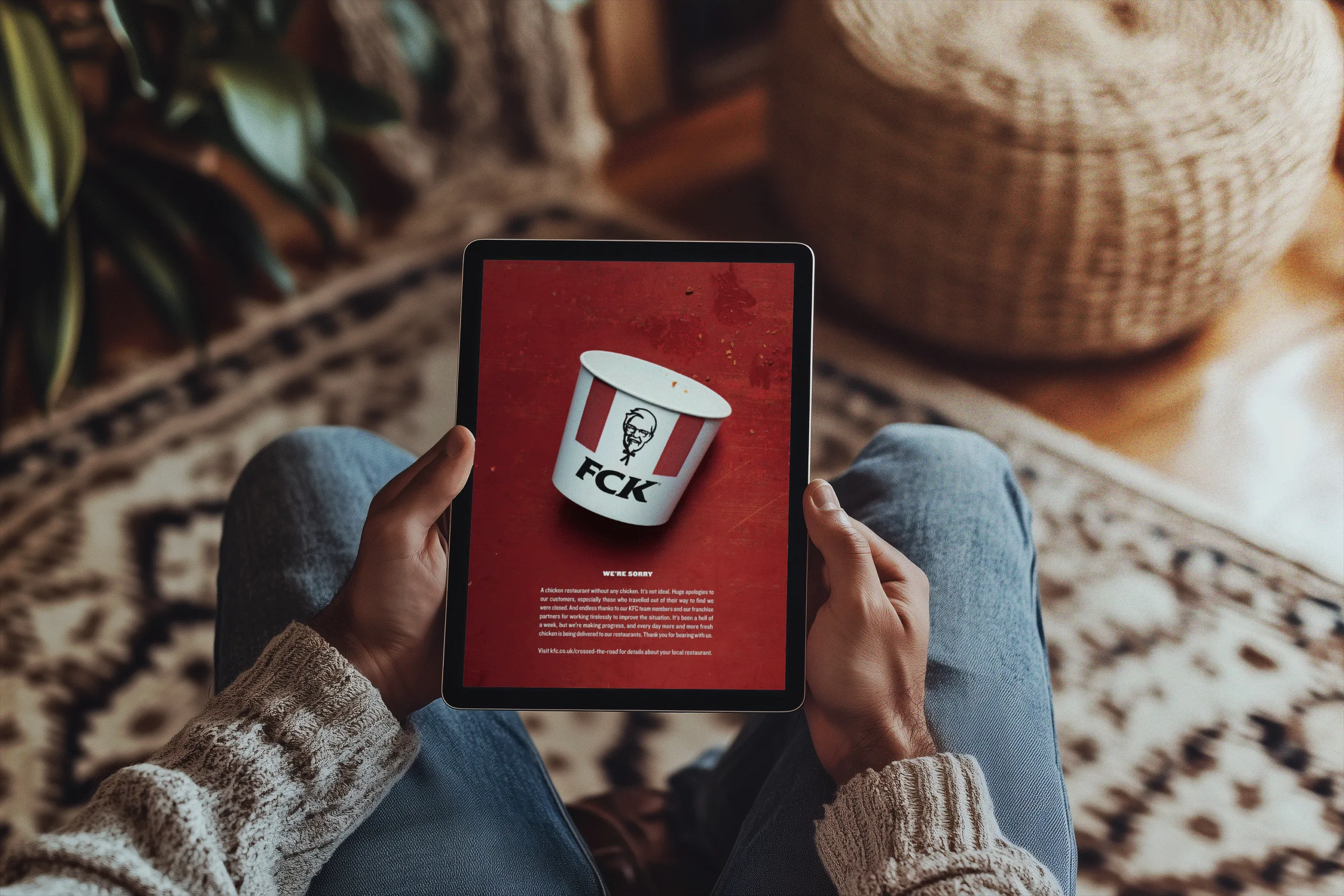
We’ve talked about this KFC ad before and we’ll probably talk about it again, but it’s an absolute masterpiece in apologies.
Although, side note: their first attempt at addressing this situation was an absolute flop 👇
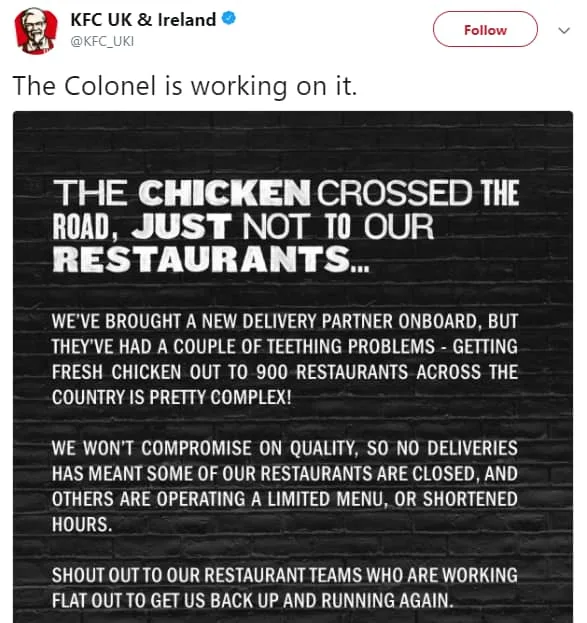
Passing the buck? Making light of the situation? No apology at all?
It’s no surprise this backfired on them. It shouldn’t have seen light of day.
But it did lead to them launching this PR response Hall of Famer in the national press a few days later 👇
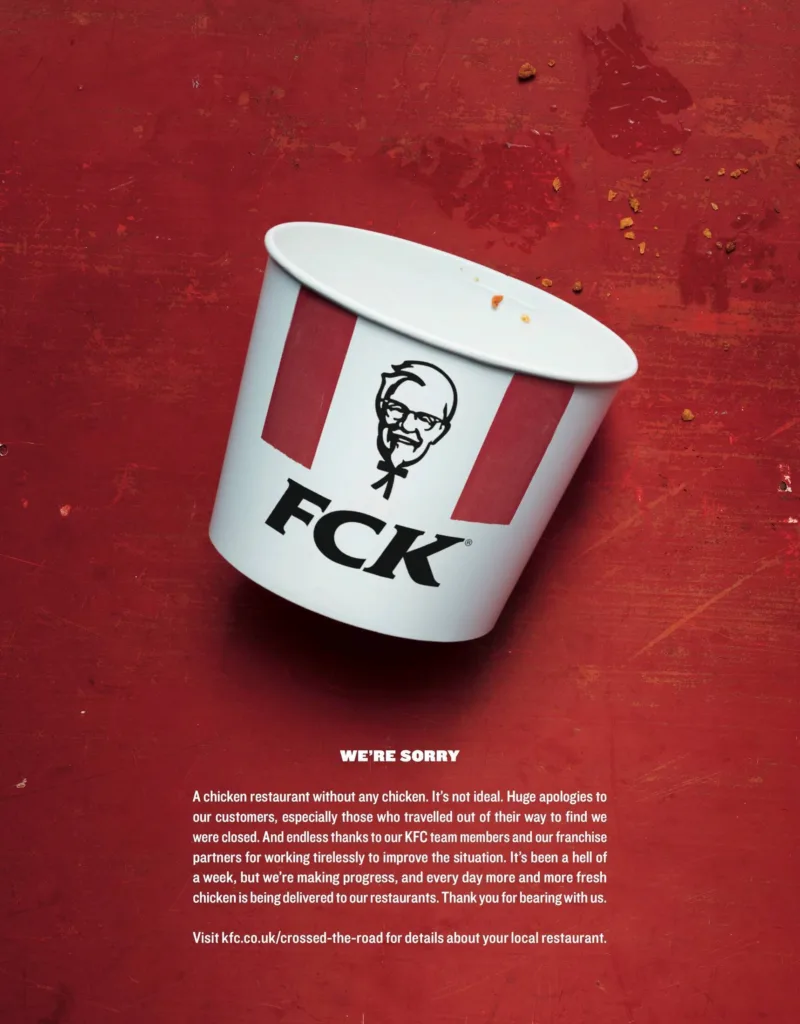
In one fell swoop, they fixed all the problems from their first apology and delivered an ad that went straight into our swipe file.
👉 They own the problem clearly: they don’t pass the buck. They say “huge apologies” and acknowledge that the situation isn’t ideal.
👉 They acknowledge the impact on their customers. They’re not just saying “we apologise for any inconvenience”. They get really specific in the impact by saying “travelled out of their way to find we were closed”. That’s smart. It shows empathy and understanding.
👉 They show that they’re fixing the situation. They highlight that they’re making progress and demonstrate that they care about getting it resolved. Customers love that.
👉 They thank everyone. By thanking customers and staff, they show genuine remorse, come across like an employer who cares about its staff and a company that cares about its customers. Smart.
👉 They offer a simple next step. KFC don’t want this to be the end of the customer journey, so they give them an action to take. (You can do the same with a discount code or a nudge towards repurchasing.)
👉 It’s all in a real, human and proportionate tone. KFC are serious about the impact, but it’s still written like an actual person. They don’t overcorrect either. Their tone is proportionate to the scale of the mess up, it’s not “we’ll work tirelessly to regain your trust” corpo-nonsense.
That last point is important.
Because the whole thing is wrapped in a human, on-brand tone (and it cleverly uses a swear word) it breaks the tension and makes you smile just enough that you sort of forget that you’re a bit annoyed.
☝️ And that approach is the model you want in your head when you’re writing the “we’re sorry messed up your Black Friday order” email.
Be human. Be real. Acknowledge the mistake. Own it. Then make it right. (A bit of humour never hurts, either. As long as the joke is at your expense, not your customers’.)
Our top tip: have some “we’re sorry” messaging written ahead of the chaos kicking in
If you leave this email with one bit of advice, make it this: write your sorry messages before the chaos hits.
If you’ve got a bank of “we’re sorry” copy ready to ship before the shit hits the fan, everything changes.
Not only can you write a response calmly without the ticking time bomb pressure of needing the copy to go out ASAP… but it also changes the dynamic of the chaos too.
Suddenly, a website outage or a broken voucher or products selling out too fast isn’t an “oh shit, our hair is on fire” moment.
Instead, it’s just “oh, we have a plan that flips this into a win for us. Let’s fire that email from our Klaviyo templates.”
And best of all? Because it’s locked and loaded ahead of time, you look like a competent brand with your shit together straight away.
All massive wins.
So take an hour or so before the chaos to write a “we’re sorry” email (a real one this time, not like that social trend we talked about a few weeks ago), an “oops, we messed up” social media post and a few little snippets for your customer support team.
Something like this:
Hey [Name],
So… it looks like our website has decided to take a sick day.
[Yesterday/Earlier] our [site / checkout / discount code] broke just as a bunch of you were trying to checkout.
That’s on us. We didn’t anticipate that much traffic so fast and it [crashed our site]/[frazzled our discount code system]. We’re really sorry about that.
The good news though? We’ve fixed it and made doubly sure it doesn’t happen again.
And to say thank you for bearing with us, here’s a discount code [CODE] for XX% off plus a little extra: [X% off / free shipping / bonus gift] too.
Just our way of saying thanks for giving us the chance to fix this. We massively appreciate you being part of our community.
Thanks!
[Your brand] team.
Just having a “pull in case of emergency” email template like this with a pre-built discount code all locked and loaded in your Klaviyo before the chaos is a huge win.
You can send it out fast, you’re reframing the mistake as something you’re grateful to them for dealing with (which is proven bit of messaging judo) and it’ll win back some customers.
Then, if you’ve got time bank a general “we messed up” IG post that’s ready to go too.
It doesn’t have to be overly polished. Even something quick like this ticks all the boxes 👇
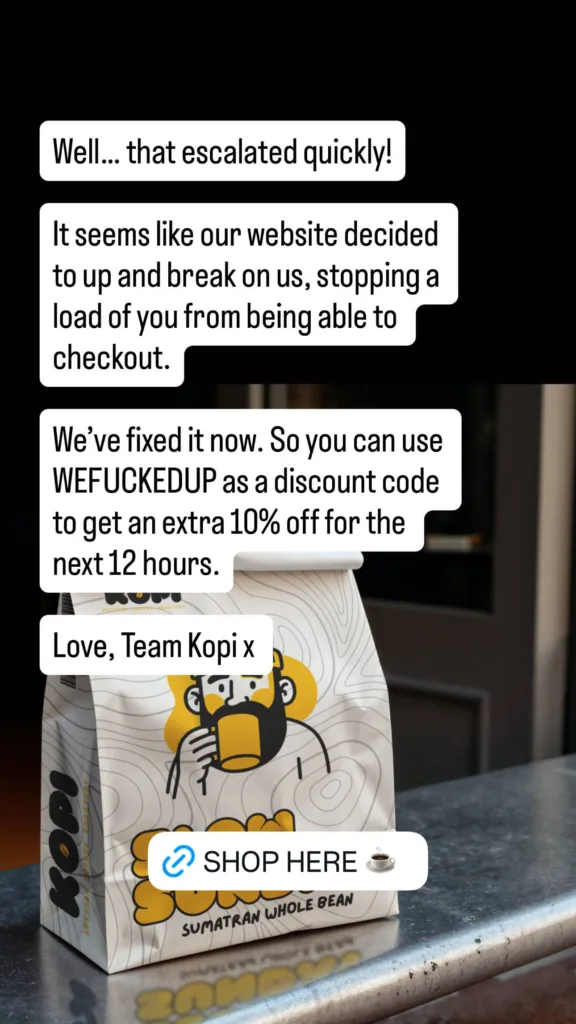
Not only does this post massively increase your chances of winning back customers and makes your brand more likeable, it’s got all the same thumb-stopping qualities as those fake apologies you’re seeing all over your feed, so we’d wager it drives a load of new customers too.
So take half an hour or so, get those locked and loaded and make sure the stress of things going wrong is turned into “ok, nice. We have a plan to make turn this into an advantage”.
Want us to review your copy & messaging for free?
Every week, we set aside some time to do video reviews for brands that feel like they might need a hand with their messaging, copy or voice but aren’t really sure where to start or what’s working and what needs fixing.
☝️ If that sounds like you, we’d love to record a personalised 15-min Loom video on your brand.
We’ll spend 15 mins walking through all the copy fixes we can see on your site, any low-hanging fruit that could be costing you sales and even some bigger picture ideas on where you’re at with messaging, positioning, voice, etc… all based on our experience doing this for ecomm and retail brands like yours for the last decade.
Sound like something that’d be helpful for your brand? Book your free audit here!