
Steal Bloom & Wild’s tips for writing better Mother’s Day copy
Struggling with Mother's Day messaging? You're not alone. It's hard. Luckily, Bloom & Wild nail it as always.

👋 Quick heads up: this article talks a lot about motherhood and mums. If that’s a delicate topic for you, please feel free to skip this one.
It’s Mother’s Day this weekend in the UK, which means that your feed and inbox (as well as our feed and inbox) is probably already full of mum-related messaging.
And for the last year or so, we’ve been sitting on a draft of this article about Mother’s Day copy, going back and forth on whether we were the right people to send it.
(Because, let’s face it: the last thing the world needs is more men having strong opinions on motherhood.)
But then we went through a load of Mother’s Day copy and we spotted some subtle pitfalls that can make your copy feel a bit icky, even if you’re writing with the best of intentions.
So we thought it was worth sharing.
That said, before we get into it, a quick note: we’re two men. Jack’s a dad, we’re both partners, we’re both sons. And we’ve spent a lot of time reading the research, going through as much Mother’s Day copy as we could find, talking to the mothers in our lives about it… in other words, we’ve tried to do this article as well as we possibly can.
But we’re not mothers. And we’re not women. And we know we’ve probably got blindspots.
So if anything in here feels off, or you’ve got something to add, drop us a line to hello@dowordsgood.com.
💡 This week’s big idea: write Mother’s Day copy that celebrates who they are as people, not what they do or what they give up.
Remember last year when we went through a load of Father’s Day copy trying to work out what made the good stuff good?
Unsurprisingly, the good stuff wasn’t about BBQ dads or golf dads or DIY dads. The good stuff showed him as a dad. Not a hobbyist with children somewhere in the background. An actual father, with an actual relationship with his kids.
So we turned to Mother’s Day expecting to find lots of mums-as-walking-to-do-lists copy.
And that was definitely the case.
But it went a lot deeper than that, too.
What we actually found was that a lot of Mother’s Day copy does the opposite thing to Father’s Day copy.
Where Father’s Day forgets the dad of it all, Mother’s Day sees nothing but the mum.
In other words, the person with an identity outside of being a mum completely disappears into this blur of mum-shaped busy-ness.
She becomes almost entirely defined by what she gives, what she does, what she goes without…
In fact, research from Peanut found that 94% of mothers feel their identity has been reduced to a single thing since having a child. Just: mum.
So, once we’d noticed this, we thought we’d try to take a particularly bad example we found and try to make it better…
…aaaaand immediately hit a wall.
But it wasn’t because we didn’t know what to say. It was because it became a game of gender role whack-a-mole.
When you write something that celebrates all she does, it’s so easy to fall into the trap of reducing her to little more than a to-do list.
So you move away from that and celebrate who she is outside of motherhood as well. (Things like her interests, her history, her personality…)
But then it starts to feel like you’re implying there’s a right kind of mum and a wrong kind. That the busy mum who hasn’t had time for hobbies lately is somehow doing it wrong.
So to fix that, you bring the focus back to the relationship itself, because research consistently finds that mothers consistently say that their relationship with their children is one of the most meaningful parts of who they are.
But then you lean into that and suddenly you’re back where you started: writing a woman who exists entirely in relation to her kids.
Every move we did to “fix” something felt like it broke something else.
Which is maybe why so much Mother’s Day copy ends up reinforcing problematic ideas of motherhood.
Because, the truth is, writing Mother’s Day copy is really bloody difficult.
It’s not just a copywriting challenge.
You’re navigating language that’s been shaped by centuries (millennia, even) of damaging ideas about what mothers are, what they’re for, and what they’re allowed to want.
And those ideas are so baked in to the way we (as a society) write about mothers that they often sneak in uninvited, even when you’re writing with the best of intentions and trying to avoid them.
So, when you’re up against a deadline with ten other fires to put out, playing it safe with a “thank her for everything she does” bit of copy is sometimes all you can do. That “change the way the world sees mothers” brief has to wait for another day.
But luckily, we found a brand that showed us that you don’t have to go full Gloria Steinem to write good Mother’s Day copy.
You just have to look to Bloom & Wild.
Learn from the masters: how Bloom & Wild nail their Mother’s Day messaging
We went through a lot of Mother’s Day copy last year. Emails, social posts, ads, the lot.
And nobody does it better than Bloom & Wild.
(We already wrote about their empathetic as hell opt-out approach.)
All year round, their copy absolutely nails writing about emotional truths and raw honesty in a way that feels really real and authentic, especially in places where other brands would resort to neat, sepia-toned sentimentality.
Their copy celebrates complexity and messiness and relationships in a way that side-steps all of the pitfalls you see in lots of Mother’s Day or Father’s Day or whatever day copy.
And we absolutely 💛 it.
We mean, just check this out 👇
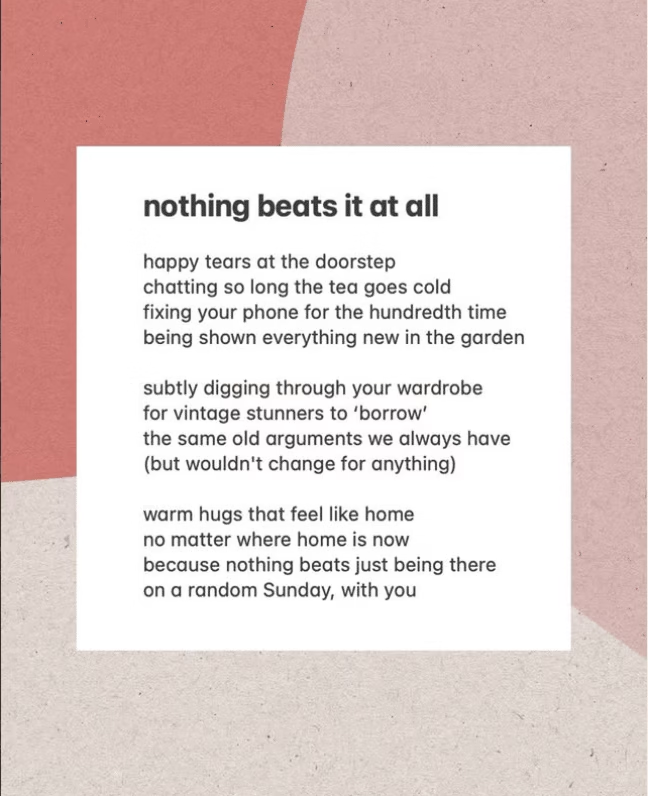
Notice how none of the things in this post are “mum jobs”.
There’s no celebration of invisible labour as a badge of honour.
There’s no talk of remembering the dentist or replying to the school WhatsApp.
There is just moments of connection between a parent and child.
And all of these specific, slightly mundane and relatable moments paint a far more complete picture than any “she deserves a break” copy ever could.
And under the hood, it’s doing a few really clever things:
👉 The specificity is doing a lot of heavy lifting. We’ve talked about specificity so many times, and there’s nothing new to add here. But just to recap: specificity in your copy will always beat hand-wavy catch-alls.
Bloom & Wild’s use of “Fixing your phone for the hundredth time” is specific and real, so it doesn’t matter if we don’t all relate to that exact scenario.
Why? Because everyone has a version of the thing their mum does that drives them a tiny bit mad. The specificity means we don’t relate to the detail of the phone, we relate to the hundredth time of it all.
And that’s the magic. Because then, instantly, we’re all thinking of our relationships with our mums. (And, by extension, thinking about buying them a gift.) Clever, clever stuff.
👉 It’s deliberately gender neutral. If you read the piece again, you’ll notice that there’s no genders mentioned, at all. (We didn’t notice this on our first read, either.)
It doesn’t say it’s a daughter standing at the doorstep, or a mum’s wardrobe being raided, or what kind of family this is.
Most Mother’s Day copy — even the well-intentioned stuff — defaults to a few tired portraits of genders and gender roles.
Bloom & Wild don’t do that. They write about a real, specific, recognisable relationship and leave the gender of everyone in it completely open to interpretation.
Remember when we wrote about inclusive language last year? We talked about the difference between additive language (bolting on extra groups so more people feel included) and transformative language (where you write in a way that makes more people feel included naturally)?
Well, this is what transformative inclusive language looks like in action. It’s really specific, well-written copy that never sets up the exclusion in the first place. All people who identify as mothers are included here. And all maternal-adjacent relationships (grandmothers, aunties, chosen family…) feel represented too. So good.
👉 It acknowledges the real, more messy side of things. Most Mother’s Day copy ends up very soft-focus and generic. Super mums and perfect mums and I couldn’t wish for a better mum mums…
That kind of copy has no texture and no realness, so it doesn’t resonate. Bloom & Wild’s copy acknowledges that real relationships contain disagreement, frustration, and the friction that comes from knowing each other too well.
And what we really love is how it frames that friction not as something to overcome but as something to cherish because it makes your relationship real.
This isn’t just a nice touch. Research consistently shows that authentic representation matters deeply to mothers. Peanut’s research found that 84% of mothers want a more honest, balanced depiction of parenthood, not a sanitised version of it.
👉 It builds to the emotion, it doesn’t lead with it. Look at those last lines: warm hugs that feel like home no matter where home is now because nothing beats just being there on a random Sunday, with you.
If the post had opened with that, it would have been fine. Perfectly pleasant. But it would have felt a bit Hallmark card-y and washed over you.
Instead, by building up to it, it lands so much better.
After the references to cold tea and borrowed cardigans and the same argument you’ve had a hundred times, you’ve experienced something called narrative transportation. You’re not really reading anymore, you’re actually (on a brain-level) much closer to experiencing it in real time and mapping those emotions onto your own life.
And because we’ve done that, when we get to the objectively slightly generic sentiment, it doesn’t feel generic and broad anymore. It feels specific to you and your mum.
And there’s a neat little structure trick you can steal to do that: start your copy zoomed in, end it zoomed out.
Don’t say “Show your mum how much you love her this Mother’s Day” as your opening line. Build to it.
List the small things she does that make you smile. The things she thinks you don’t notice. The things not related to being a mum.
Then, pivot into that broader emotional copy.
That way, the emotions you’re evoking are felt by the time they read it.
(And, handily, that makes them more likely to buy, too. Studies consistently find a strong correlation between the proportion of customers that experience intense emotions when they’re reading copy and a strong intent to buy.)
👉 It paints the picture of a mum that has an identity outside of being a mum. With that throwaway line of vintage stunners to “borrow”, Bloom & Wild are nodding to the mum’s identity outside of having kids. She has good taste, she has occasion to wear these dresses…
Sure, it could go a little further. (We’d love it to show the mum having a rich life currently, rather than the slight suggestion that her non-mum identity is a thing of the past. But that’s nit-picky.)
But even this little hint is doing a lot of work. And it’s doing something that lots of Mother’s Day copy doesn’t do: painting mums as people with interests beyond to-do lists and their children.
And with only 19% of UK mothers believing there are examples of mums in advertising that they can relate to, it’s also something that’s going to really help your brand stand out.
Let’s see this in action
Now, the Bloom & Wild piece is great, but it’s a social media post. It doesn’t need to sell per se.
So what happens when the brief changes?
What happens if you’re writing copy that needs to sell and not just get likes and shares?
Well, let’s have a go and see.
And let’s make it really hard for ourselves.
Let’s take the most self-care, “mum deserves a break” product (an at-home spa kit) and write some copy that avoids as many of the pitfalls as we can.
Here’s where we ended up 👇
Their playlist used to be wall-to-wall 90s hip hop. Now it’s a mix of throwback bangers, 10-hour white noise loops and the Hey Duggee theme on repeat.
Their evenings used to run late because they didn’t want the night to end. Now they run late because it’s World Book Day tomorrow and that Supertato costume definitely isn’t going to make itself.
Their Sundays used to be long and unplanned. Now they’re a beautiful, chaotic game of baby hot potato where you’re both just trying to finish a hot drink.
And they wouldn’t change that for the world.
But at the same time, those few hours with a hot bath, a candle and their favourite tunes? That’s their sanctuary.
So this Mother’s Day, swap the leftover cucumber, tea light from the back of the drawer and the last drop of the bubble bath for a proper candle, a real eye mask, and a playlist made just for them.
This was hard.
As hard as we tried (full disclosure: this is version 19), we couldn’t out-write the inherent slight whiff of “mum deserves a break” that’s baked into the gift itself.
But compare it to this slightly tweaked bit of real-life copy we found on our travels:
This Mother’s Day, give your mum the break she truly deserves with our spa break box set. Contains a soy candle, face mask, organic bath bomb and a personalised Spotify playlist so she can finally take some time for herself.
In comparison to that, ours is warm, it’s specific, it’s gender neutral, it’s free of any talk of tasks and invisible labour, it feels like it celebrates a person who also happens to be a mother, it implies a shared parental load, it starts zoomed in then zoomed out…
7/10, maybe.
And here’s how we dodged most of those gender role whack-a-mole pitfalls:
👉We didn’t split them into “before mum” and “after mum.” We tried to write a mum with a whole of personality, but avoid framing it as something lost or something she needs to reclaim. This is who she is now, complexities and all. And the playlist became a really handy metaphor for that new, blended identity.
And, of course, the specificity of that playlist is why it feels real.
(It’s also very, very much based on Jack’s Spotify Wrapped from last year.)
👉 It reflects real life, messiness and all, without making her a martyr. The Supertato costume and the baby hot potato are shown as hard work, but they’re also funny and relatable and real. And, crucially, it’s never turned into “look how much she sacrifices.”
👉 The gift doesn’t give her permission to rest, it just upgrades something she already does. This was the hardest part of the whole thing. Our first attempts kept slipping back into this icky idea that the bath itself was a gift. Then we realised that the time to herself wasn’t the thing we’re selling. We’re selling a better version of it. Handily, that helped us hit a completely different emotional register, and sidestep the icky framing of Mother’s Day presents as reparations almost entirely. Sometimes, stepping back makes all the difference.
👉 It has a cliche final line, but it works. “For a few hours, this is just for them” is not a remarkable line on its own, we’ll admit. It’s very Richard Curtis.
But by the time you reach it, you’ve lived through three specific, recognisable moments. You’re feeling the moment more than reading it.
And that means that a fairly ordinary sentiment lands more like gratitude and love than cliche.
(Which is the real benefit of starting zoomed in, ending zoomed out. You don’t need to write a game-changing final line. You just need to it to be heartfelt.)
If there’s one thing to remember, it’s this: instead of writing about mums, just write about people.
The moment you’re writing about a specific person with specific tastes and a real life that isn’t all about their role as a parent, you’re doing it right.
The moment she becomes a monolith of selflessness and sacrifice (and it will almost definitely happen, even if you don’t want it to) take a step back and find a new path.
And if you’re mid-whack-a-mole with your own Mother’s Day copy right now, send it over and we’ll take a quick look. We’ve had a lot of practice this week.