Steal Spacegoods’ messaging trick to appeal to more customers
Steal Spacegoods’ smart messaging trick to widen your audience, beat marketing myopia, and show how your product fits in customers' lives.
💡 This week’s big idea: it’s so easy to get obsessed with your brand and category. But the best messaging comes from zooming out.
In the 1960s, Theodore Levitt wrote in the Harvard Business Review about something called marketing myopia. In that, he said that most brands’ marketing “invariably drifts in the direction of thinking of itself as producing goods and services, not customer satisfactions.”
In other words, it’s very easy to think of your products as just products. You’re just selling beer or you’re just selling meal kits or you’re just selling coffee…
And to an extent, that’s true.
But there’s more than that, too.
Levitt uses railroads as his example (it was the 60s, after all) and says that railroads got replaced by cars and planes because “they assumed themselves to be in the railroad business rather than in the transportation business.”
As a less archaic example, as Netflix was starting to become a thing, Blockbuster pushed hard on ‘no late fees’ messaging and highlighting the in-store experience, while Netflix owned the ‘watch at home, whenever you want’ experience. (And we all know how that ended.)
That’s why, as easy as it is to fall into the trap of thinking customers are choosing between us and our direct competitors, we also need to remember that most customers aren’t shopping for a specific brand or even a specific category.
They’re shopping for something to do a very specific job. Things like:
“Help me feel awake without feeling wired.”
“Feed the whole family quickly without eating rubbish.”
“Get a gift there on time so I don’t look bad”
“Something to keep the kids entertained on a long journey”
That means that the job of “chilling in the evening” could easily become a category that contains a glass of wine, a CBD drink, a herbal tea, a mushroom gummy, a board game, and, at a stretch, a subscription to AppleTV+ to binge the new season of Shrinking.
All of those products become competitors in very, very specific mental categories that only exist in that customer’s head.
But that’s a category your messaging can make sure you’re in.
And all of this is backed up by studies, too.
👉 Jobs To Be Done
tells us that customers “hire” products/services to make progress in a specific situation (and, secondly, that those jobs have functional and social/emotional dimensions to them).
👉 We create categories from unrelated products all day long.
We all invent what academics call “ad hoc categories” on the fly to help us achieve very specific goals (think: “something to keep me awake”, “things to take camping” or “gifts for my nerdy brother”), rather than sticking to tidy retail categories of beer or sweets or whatever.
👉 Growth comes from making sure your brand is mentally available when people think of a situation where they’re motivated to buy.
This is classic Ehrenberg-Bass stuff. In other words, linking your brand to buying situations/needs/occasions (not talking endlessly about the brand itself) is huge for brand growth.
What does that mean for your copy? And how can you fix it?
Let’s get into it.
Myopic brand messaging is everywhere
Have you noticed that a lot of brands are starting to sound like slight variations of each other, even across categories?
There’s the same framing, same claims, same story and values and USPs, all written in the same voice.
Ipsos called it a “sea of sameness” and a recent Ogilvy report said that brand differentiation has fallen to a two-decade low.
A few weeks ago, we looked at one way out of that sameness trap when we looked at how Goodrays stand out in a market dominated by TRIP, i.e, what to do when people are already shopping for your category, but you’re getting lost in the noise.
But there’s another scenario where that advice doesn’t quite tell the whole story.
For example, if your brand is early, your category is still emerging, or you’re asking someone to change their behaviour, focusing just on how you’re different from the competition can end up feeling a bit inside-baseball.
In other words, looking like the best brand in your category doesn’t matter if your customer doesn’t know how that category fits into their lives.
In fact, a study published literally the other day says that when emerging brands grow, they tend to grow mostly by getting more buyers, not by turning existing buyers into ultra-loyal repeat purchasers.
(Luckily, this has something they call the double jeopardy effect, where getting more customers also sees an uptick in customer loyalty.)
So that means, in the early stages before you’re a household name, the more useful question is less “how do we sell this product better?” and more “how can we show the customer where our product fits in their lives better?”
Because when you’re trying to get somebody to try something new, your competitor often isn’t another brand like you, it’s whatever they’re already buying/doing to get the same outcome.
How Spacegoods zoom all the way out with their messaging
So, if you’re an emerging brand, how do you pull your messaging out of the category trap?
Let’s take a look at mushroom coffee as an example.
Because while functional mushrooms are having a massive moment, they haven’t crossed over into the mainstream yet.
And that means that any brand selling functional mushrooms can’t just talk about mushrooms and their potency, because that’s category copy. And they’re not going to grow by getting a bigger share of the small group of people that are already category aware.
Most brands in the space are writing copy that’s lots of talk about all of the adaptogens and the mood boosting effects, etc… and that’s great. You 100% need to do that, but it keeps your audience small.
But Spacegoods know that other functional drinks aren’t really their competition: the morning coffee is.
To go after that bigger group of customers, the barrier isn’t “is this better than another mushroom brand?”. It’s a) does this taste rank? and b) why should I swap my morning coffee for mushrooms?
So they have this section 👇
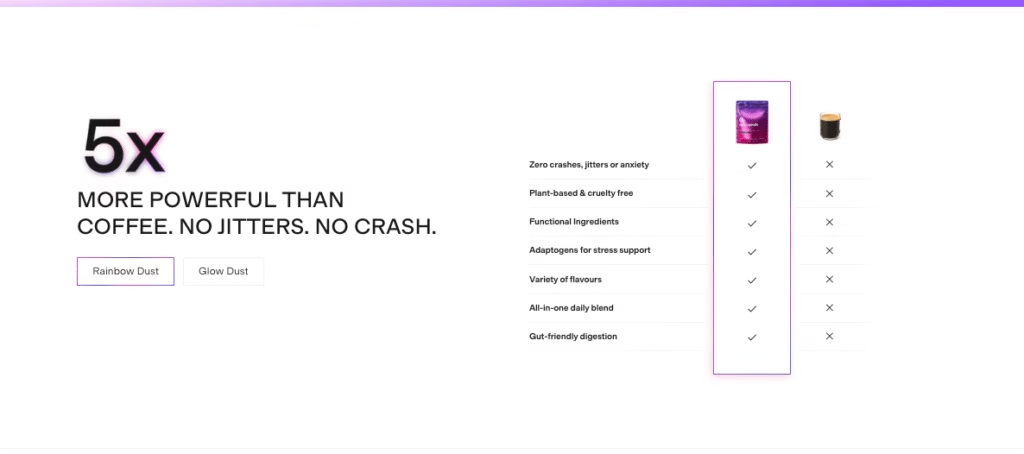
Immediately, it’s easy for customers to think “huh, I can swap my morning coffee for Spacegoods and feel better, get some health benefits and avoid the jitters?”.
That’s wicked smaht.
Because it expands their potential audience from 3% of adults that have tried mushroom powders to the 63% of adults that drink coffee every day.
On top of that, “replace your morning coffee” framing creates a strong memory link between Spacegoods and the morning category entry point. That way, when somebody thinks about buying their morning coffee (or a drink for their mornings), Spacegoods is more likely to come to mind.
And it’s also double smart, because that messaging is based in voice of customer research from customers who already made that exact behavioural change.
Look at these snippets of quotes we found in their customer reviews:
“It’s genuinely replaced my morning coffee.”
“I have replaced my morning coffee with it.”
“I’ve managed to completely cut out coffee…
“Taste is smoother than regular coffee… No jitters, no crash, just clear focus for hours.”
“Lost the need to have a coffee”
It’s like we always say: most of the time, your customers have already solved your biggest messaging problems for you.
It’s no secret that we’re huuuuuuge fans of VOC research. (As you know if you’ve been here a while.)
Whenever we work on a project, the thing we always spend the most time on is voice of customer research.
Why? Because there’s a direct correlation between the quality of the copy, the results it gets and the amount of time we’ve spent drowning in VOC data.
And if there’s one takeaway from Spacegoods, it’s this: the key to copy that gets new people to try your product for the first time, unsurprisingly, has already been written by the people that have tried your product for the first time.
In their reviews, UGC and on anonymous forums (hello Reddit) those customers practically hand you the exact ingredients you need to zoom out and spot:
- the job they’re trying to get done
- the default choice they’re currently making
- the trade-offs they hate
- the moment they decided to give you a try
- the words they use when they’re trying to explain all of that
And all of that is absolute gold-dust for writing good copy.
👋 A quick refresher course on VOC mining (and how to use it to zoom out)
VOC research sounds fancy, but at its core, it’s just reading what your customers say and interpreting it.
We always start with:
Reviews: we read them all. We look at the 1-star reviews and see what expectations they had for your product, the 5-star reviews for selling the dream and transformation.. We also pull out what emotions your products are associated with, what practical goals they’re tied to… Absolute gold dust.
Post-purchase surveys: What were they hoping this would help with? What did they use before?
Customer emails and DMs: those questions in your DMs are clues to what things your messaging isn’t telling them.
Reddit / forums / community comments: be a fly on the wall on how your customers talk about their lives, their goals, etc…
UGC captions: creators love telling stories. Look at the narratives they choose to show off your product.
Complaints/returns/refunds: this is where you’ll find out what job your customers expected you to do.
First of all, pull out any key phrases that you think are handy to repeat. (Having a bank of VOC makes writing so much easier. Like we said, be a magpie.)
Then, once you’ve got VOC in front of you, run through these questions:
What job are customers hiring you for?
Not “what do we sell?”, but what progress are they trying to make in that moment? What moment are you giving them? How do they describe it?
What situation triggers the job?
Try and get as specific as possible: time of day, social context, mood, routine, problem. (“Monday morning”, “post-kids bedtime”, “before a date”, “Sunday reset”.)
What’s their default choice?
If your brand didn’t exist, what would they do instead? This is your real competitor. (“I used to have two glasses of wine, but this CBD gummy does the same thing.”)
What’s the trade-off they hate about that default choice?
Jitters. Crash. Regret. Waste. Admin. Inconsistency. Feeling silly. Feeling unhealthy. Feeling like they’re failing. (This is usually where you find the real nuggets for nudging a behavioural change.)
What worries did they have before switching?
Risk, taste, stigma, complexity, time, price, “will it actually work for me?”. Address those in your copy + FAQs to overcome objections.
What proof do they need to try your product?
What would remove doubt? Guarantees, specifics, routines, standards, third-party cues, social proof… Look for things like “I was skeptical until…” or “I’d heard about this a lot then I saw…” That’s where the bangers are.
Once you’ve got all of that, you’ve basically got the ingredients to do two things:
Tempt people to make the switch, because you’re addressing the default, the trade-offs, and the doubts
Widen your net, because you’re framing the product in a way that makes sense to people outside of your immediate category shoppers.
☝️ And that’s a game-changer.
“Hey boys, does this only work for utilitarian products?”
Editing this, we became super aware that it feels a bit like this advice is specific to more utilitarian brands like supplements or fitness or whatnot.
But what if you sell something less practical? Something that’s more about enjoyment or identity or how you feel about yourself?
(Which is great, because Jobs To Be Done is all about how the “jobs” customers hire us for aren’t always practical. Sometimes, they’re emotional too. Or about identity. Or social.)
So we thought we’d run through an example on the other side of the fence: a £1500 pizza oven.
After all, people aren’t buying a £1500 pizza oven just to cook pizza. They’re buying because:
- “I want restaurant-level pizza at home.”
- “I want people to see me as a chef” or “I want to feel like a chef”
- “I want a new ritual that gets people to hang out at ours”
- “I want to feel like the kind of person who can cook with fire”
- “I want Matty Matheson to be my friend”
(OK, that last one is just Jack.)
And if you’re asking someone to spend some serious cash, speaking to those emotional and identity jobs matters a lot.
Because at that level, you’re not just competing with other ovens, you’re competing with BBQs, you’re competing with fire pits, you’re competing with ordering local pizza…
Either way, the answer is the same as we looked at for Spacegoods:
- Find the moment and feeling in VOC (“finally helps me unwind”, “makes it feel like the weekend”)
- Find their default choice (wine / dessert / doomscroll)
- Position your brand as the better version (same vibe, fewer downsides / more ‘worth it’)
Which takes you from this:
A restaurant-grade outdoor oven built for serious heat, fast cook times, and absolutely banging pizzas.
Designed to reach and hold high temperatures quickly, it gives you the intense heat you need for proper pizza with blistered crust, leopard spotting, and that crisp-yet-oh-so-chewy base.
The heat-retaining build and spacious cooking area make it easy to cook consistently, whether you’re turning out a pizza for one or feeding a table of 12.
And because it’s made for more than pizza, you can roast, bake, and fire-cook everything from veg and fish to flatbreads and steaks.
Which is pretty decent, right? It’s got category copy in, tangible details, etc…
But is it enough to make somebody ready to drop £1.5K? Maybe not.
The DWG104 pizza oven was born out of evenings spent around our dad’s rickety brick pizza oven.
Dad hated waiting for the charcoals to heat up on the barbie and the two of us had a pathological hatred of the gloopy pizza from the local takeaway. So every weekend, he’d fire up the oven, we’d choose our toppings and we’d sit around eating pizza as a family.
And that’s exactly why we designed the DWG104, to help you bring those moments into your life. It fires up quickly, looks really cool and gives you everything you need to serve perfect pizza after perfect pizza.
(Plus, secretly, we just wanted to build something that made us feel like Carmy from The Bear.)
The triple-layer construction means it can reach and hold high temperatures fast, giving you that intense heat needed for that oh daaaamn leopard spotting and a crisp-yet-chewy base.
Plus, when you’re done with pizza, you can use it for flatbreads, roasted veg, fish, steaks and even some banging smores.
See the difference?
When you write category-first copy, you’re mainly persuading people who already “get it”.
In this case, the people shopping for pizza ovens that are already comparing specs and already half sold.
But most growing brands don’t just need to sell to those people.
They also need more people to look at the product and go: “Ooooh, that’s a bit of me.”
That’s why the second description positions the job of the product as less “cook good pizza” and more about doing the job of quality family time & making memories.
☝️ And that’s why stepping back and looking at your category from the perspective of your customers’ lives can make such a huge difference not just to your conversion rate, but to the size of the audience you’re talking to.
👋 If this article made you think “our messaging is too category-ish”… we’d love to help.
Our one-day PDP Punch Up is literally designed to get us doing all this zoom-out work for you. We do a full head-down day of turning category and voice of customer research into a PDP that not only sells better, but helps you sell to more people too.