How to nail the “we’re sorry” trend that’s everywhere at the moment
“We’re sorry.” Why faux-apology ads are taking over your feed—and how to write one that grabs attention without losing trust.

This week we wanted to dive into why your Instagram feeds are full of faux-apology posts: because our brains cannot resist reading on to see what they’re apologising for.
However, despite the fact that it seems that every brand is running apology ads at the moment, only a few are absolutely nailing it.
So this week we’re breaking down why some of these work (and why others feel like clickbait) and how to tweak your approach to the trend depending on what kind of products you sell.
Let’s get into it 👇
💡This week’s big idea: faux apologies might be trending, but they’re hard to get right.
Anyone else’s IG feed look like this right now?
So many brands are posting “fake” apologies to stop our thumbs and get us to read their messaging.
Which is no surprise as these posts are the social media equivalent of a biscuit tin with the lid off in Joe’s office…
👉 Apologies stand out because brands are apologising less.
According to a recent Axios report, there’s a huge decline in brands actually apologising , even when they mess up. Or, as they put it, “the age of the public apology is over”. (Looking at you there, American Eagle.) That scarcity makes any “sorry” that brands put out immediately feel a little more novel than it would in the past and novel things grab our attention. (More on that later.)
👉 “We’re sorry” is a clever pattern interrupt.
In our brains, seeing an apology in the context of a social media feed where brands typically try to present the best version of themselves stands out. Basically, we scroll absent-mindedly and everything blurs into one. Something that is novel stands out, grabs our attention and makes us remember it for longer. (That’s a mix of the oddball paradigm and the Von Restorff Effect .)
👉 It creates an open loop that our brains want to close.
Remember when we talked about Surreal’s clever social media posts and how they created a loop that our brains absolutely needed to close? Well, it’s the same thing here. That gap between “We’re sorry” and what they’re apologising for creates an itchy open loop in our brain that bugs us until we close it. (This is called Information Gap Theory , which says that we’re drawn to want to seek out information to “close the loop” on open-ended questions.)
However, there is a catch to all this cleverness.
We know we all work in an attention economy and that every second of eyeball time we win counts.
Yet every bait-and-switch copywriting technique we use to grab attention also has the power to damage your brand’s reputation and make customers trust you less.
In fact, a bunch of recent studies show the same thing: clickbait tactics or tactics that bait-and-switch boost short-term engagement but damage your long-term credibility.
Another study tracked social media performance and found clickbait-style headlines got 25% more clicks but 60% fewer shares and repeat visits.
Basically, you can only pull a trick so many times before people scroll right past you. Which means the stakes for this trend are pretty high.
Nail it and you’ve grabbed attention and have an opportunity to show how awesome your brand is. Misfire and you’re getting eye-rolls at best and “ugh, I trust this brand less now” at worst.
Luckily, there are few ways to do it that completely negate the potential pitfalls.
Let’s get into it 👇
How to make an apology ad land (without denting trust in your brand)
While we’ve been writing this newsletter, we’ve seen a lot of these kind of apology posts.
Like, a lot.
(Not only did we send out the Bat-Signal to our friends to send over examples they spotted, but the algorithm then did its thing and our feed was suddenly full of them.)
But the vast majority of them fell flat. Some of them were too heavy on the bait-and-switch, while some of them just suffered from trend fatigue where it felt like “urgh, I’ve seen this before.”
But a few brands had really clever approaches that not only kept our attention, but managed to avoid the bait-and-switch of it all completely.
How Riddim and Wick Guru used humour to nullify the trickery
We’ve talked about this before when we looked at Who Gives A Crap, but being funny as a brand is a really smart way to get away with some really clever copywriting tricks without the downsides of appearing icky or gross.
Just check these ads out from Riddim Snacks and Wick Guru 👇
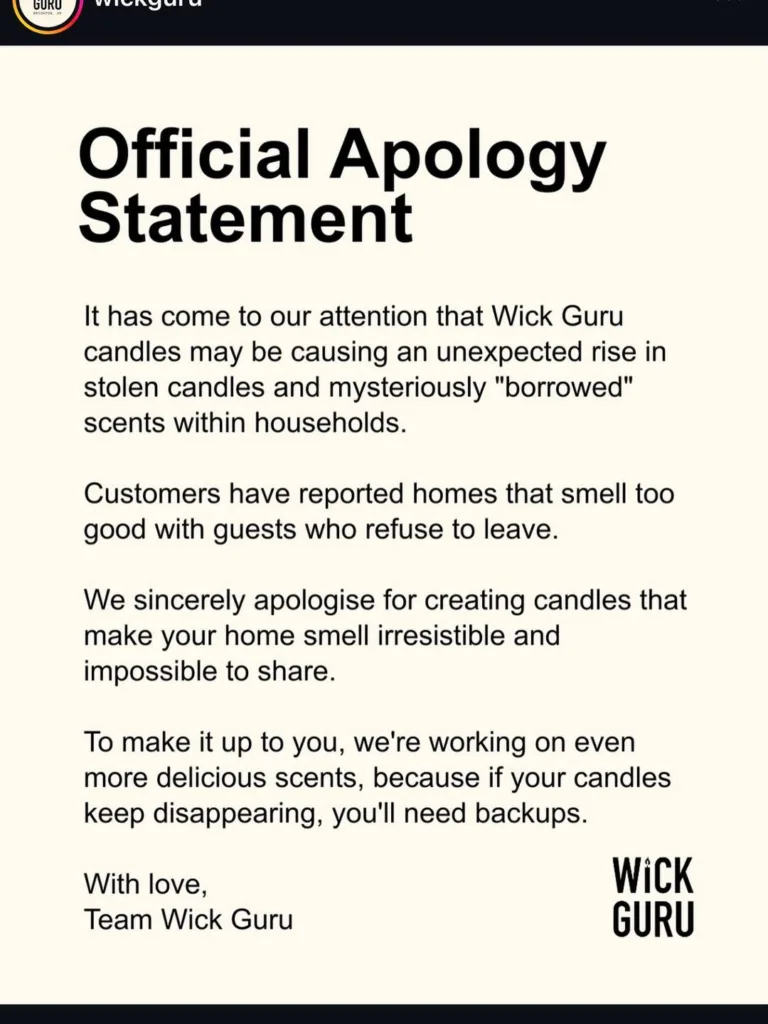
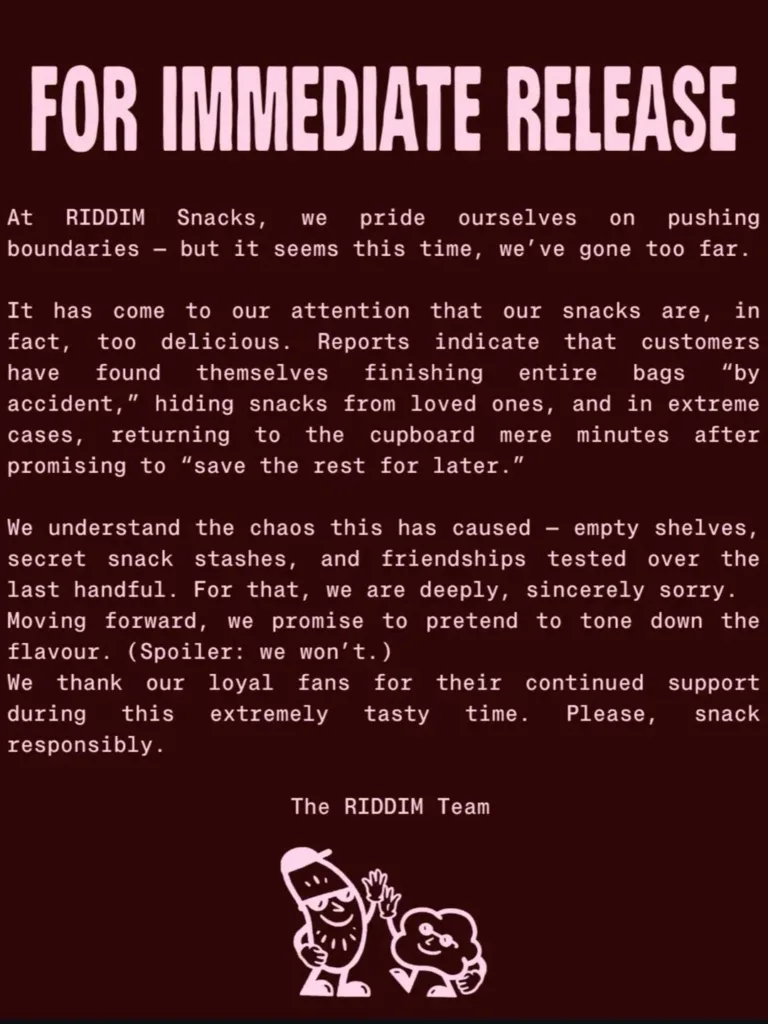
When you read these ads you don’t feel like you’ve been duped or tricked, right?
And you don’t roll your eyes either?
That’s because they’re funny. They’re deliberately over the top. They’re absurd. They’re not taking themselves seriously at all.
Immediately, both of these brands send very clear “we’re just playing here” signals that negate all of the rope-a-dope effects of the headline.
Remember when we talked about benign violation theory when we looked at Big Tea’s ad? The same thing is happening with these two posts.
Basically: the Riddim and Wick Guru posts are funny and not click-baity because they break a rule without hurting anyone.
And by really dialing up the over-the-top tone, the absurdity of the examples and the tongue-in-cheek-ness, these two brands manage to change the “we’re sorry” framing from rug-pull engagement bait into the set up for a joke.
And that’s really smart. Because it means that they’re no longer tricking you into reading, they’re inviting you into the joke.
👋 Why humour is a super-smart move for this trend
In the book Inside Jokes, humour researcher Matthew Hurley calls laughter a “reward for successful pattern recognition.”
That’s because, when you get a joke, your brain releases dopamine as a kind of “well done” for spotting the twist.
And that microdose of pleasure gets attached to whatever triggered it. And in this case, that means our brains associate Riddim or Wick Guru with pleasure slightly more after seeing these ads.
So instead the cheap adrenaline spike of clickbait that’s quickly followed by disappointment, these brands build a moment of reward and rapport.
And that’s exactly why their posts don’t feel manipulative even though, technically, they’re doing a bait-and-switch.
(Note: as the trend gets bigger, the opposite is happening too. As the trend blow up, it’s becoming less bait-and-switch and more like customers are expecting to read something that stands out. Both sides know it’s a pantomime, so the brand needs to deliver on those expectations. Funny ticks both boxes. Super-smart.)
But humour isn’t the only play, as Honest Mobile demonstrate…
How Honest Mobile use their apology ads to show their challenger spirit
We’ve talked before about how Honest Mobile are absolutely killing their ad copy and this one is no different.
Check it out 👇
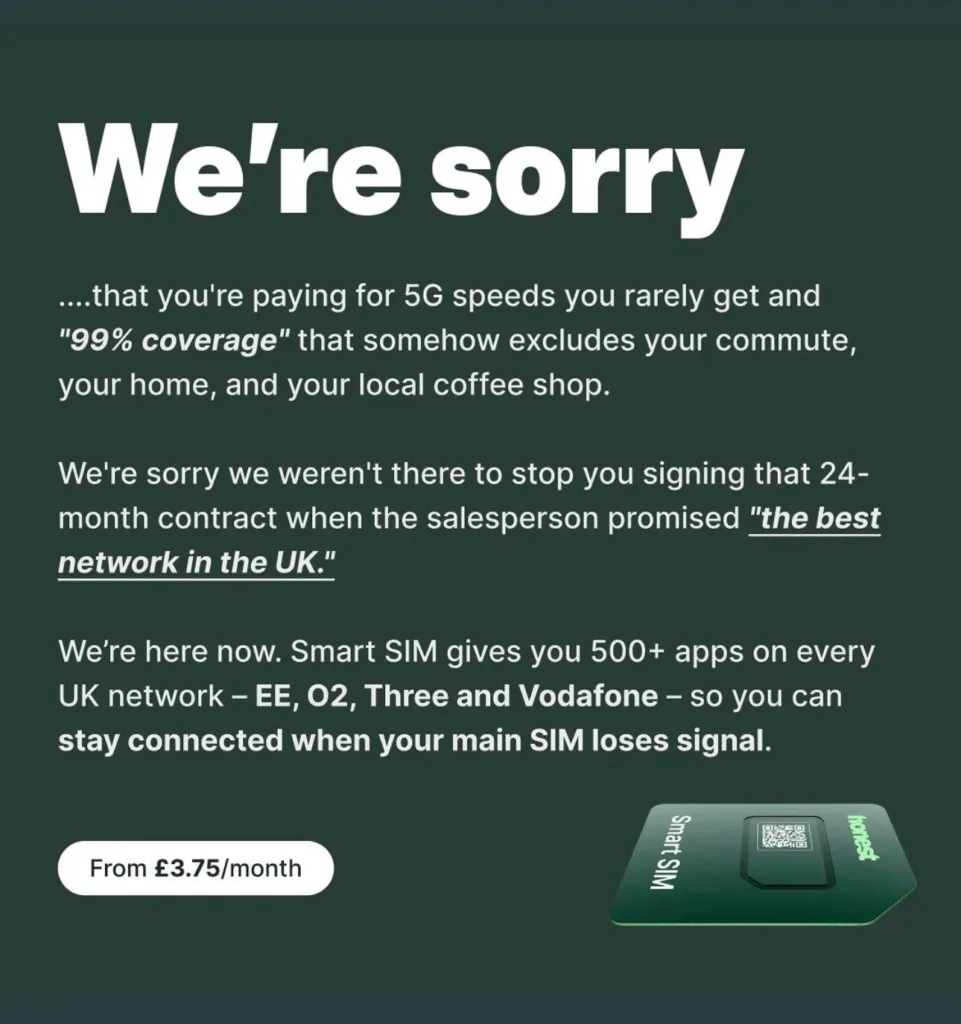
Unlike candles or snacks, Honest Mobile know that a quick joke isn’t going to change people’s minds on their brand.
In fact, as we said a few weeks ago, in categories like telecoms, insurance, or banking — AKA utilitarian products — purchase intent skews toward risk avoidance and problem solving.
And while Riddim or Wick Guru use their apologies to make you smile because their products are designed to bring you joy, Honest Mobile use theirs to show problems and their solutions because their product solves a problem.
That’s super smart.
And it’s doubly smart because this ad is built on the same benign violation as the funny ones, it just moves in a different direction.
Benign Violation Theory basically says something is engaging (or funny, or just cognitively rewarding) when it breaks a norm but does so in a way that still feels safe or justified. The violation grabs our attention, the benign-ness lets us enjoy it.
So while the Honest Mobile ad doesn’t go for laughs, it still does the same mechanism of subverting the expectations. It does apologise, but it’s not a mea culpa like we expect. It’s an apology for the industry they’re in.
(Which means they dodge the clickbait expectation-reality gap too. Smaht.)
And that clever little move lets them pivot into some really well done challenger brand language that acknowledges everything customers already feel frustrated by: slow data, “99% coverage” that excludes your house, and 24-month contracts that feel like hostage situations.
They get to set up problems and present themselves as the solution, all wrapped up in a structure that is designed to grab (and keep) customer’s attention.
More importantly, it doubles down on what challenger brands do best: moral contrast.
In other words, the unmissable takeaway from this ad is: “Those other networks take advantage of you. We’re not like them.”
It’s smart. It’s memorable. And it positions Honest Mobile as standing shoulder-to-shoulder with the customers, not talking down to them.
Again, they’ve smashed it. No notes.
The common theme across the winning ads? They position their brands as alongside the customer
From Riddim talking about demolishing a bag of snacks to Wick Guru talking about guests overstaying their welcome to Honest Mobile calling out their own industry’s BS, all three of these ads win by talking to the customer as equals, not as brands that are above them.
That’s the red thread that ties all the best faux-apology ads together: they don’t talk down, guilt-trip, or lecture.
Instead, they share a moment of humour, of frustration, of we-get-you-ness… that says, “We get it. We get you.”
That’s why the copy feels more relatable. That’s why the tone feels more trustworthy or genuine. And that’s why their message lands.
And that is the massive difference between the ads that really nail this trend and the ones that just don’t quite land: how they navigate that dynamic between brand and customer.
Check this ad out from AKT that comes so close to nailing it 👇
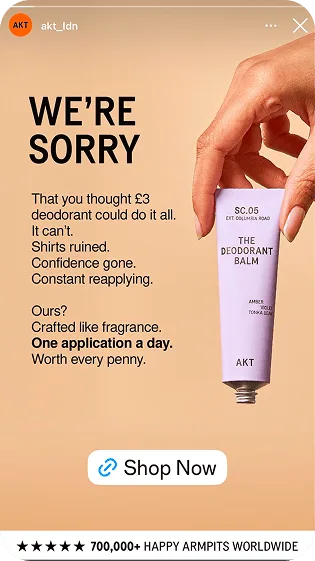
At first glance, this looks like it belongs in the same “challenger brand apology” bucket as Honest Mobile.
It uses the same visual language, the same big “We’re sorry” headline, conversational tone and problem–solution flow, but there’s a 2-word phrase that completely changes the effectiveness of this ad:
“You thought.”
Those two little words completely change the tone of the ad. They shift the blame onto the customer.
The ad is no longer “you’ve been misled into thinking this”. It’s “you’ve been naïve.”
So, even though the rest of the copy does its job, that 2-word opener subtly builds an irreconcilable distance between brand and reader.
And that means that it’s far less likely to be read, remembered or to build any brand affinity or loyalty.
But look what happens when you tweak just those two words 👇
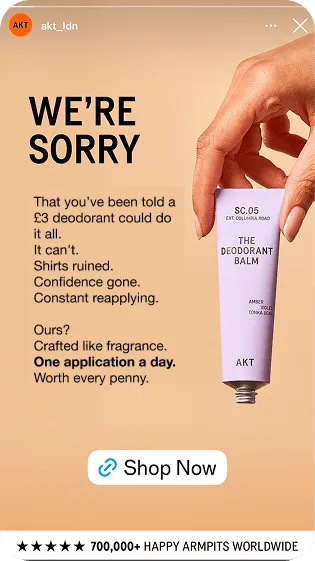
Boom. Immediately, the brand is standing alongside their customers saying “we’re sorry you’ve been lied to. We’ve got you”.
Game-changer.
So if you’re thinking of jumping on this trend, remember these three golden rules:
1. Don’t punch down. The joke or challenger attitude shouldn’t be at your customer’s expense. Make yourself or the industry the punchline, not the customers.
2. Match your emotional register to how your customers think. If you’re selling joy (snacks, candles, clothes), lean into humour and sparking joy. If you’re selling fixes or utility, lean into empathy and logic. The goal of these ads isn’t necessarily to be funny, it’s to speak directly to your audience’s mindset.
3. Stick the landing. Mitigate the inherent risk of the fake “We’re sorry” with a payoff that makes them feel like it was worth the trick. Whether that’s a laugh, a moment of recognition, or a genuine fix, the twist has to feel earned and, crucially, harmless. If they feel duped or feel like they feel worse about themselves for reading it, give it a rewrite. (But, like we said, sometimes it’s literally just a matter of changing a few words.)