💡 This week’s big idea: AI not “getting” your brand voice isn’t really an AI problem at all. It’s a brand voice document problem. (Part 2)
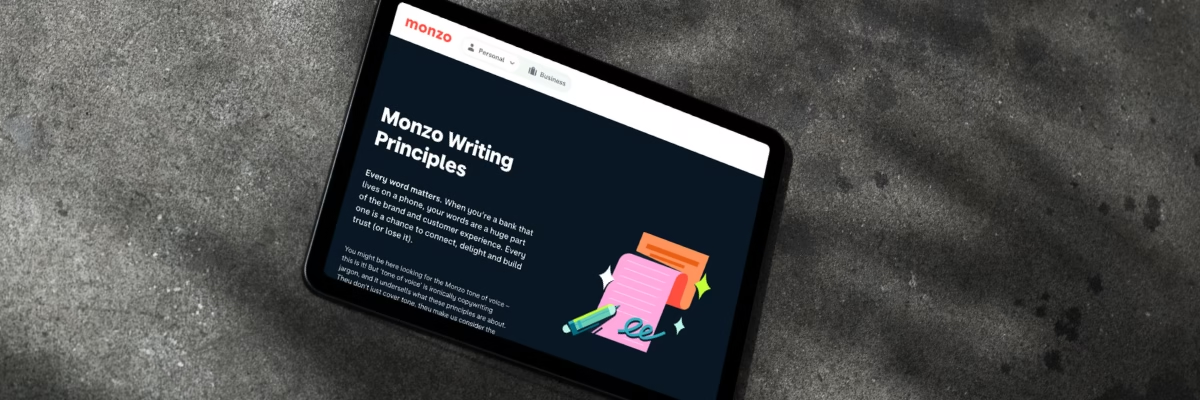
A few weeks ago, we took Monzo’s brand voice document, one of the best brand voice documents in the game and gave it to AI to try and replicate.
Suffice to say, it didn’t do a great job.
Sure, when we gave it a more detailed breakdown of their voice it got closer but it didn’t nail it.
So for the next few weeks, we’re going to be breaking down some things you can do to your brand voice documentation that make it easier for people and AI to follow.
The thing is: most brand voice documents are written for writers.
Even more specifically, they’re written for writers who already have taste.
People who’ve spent years reading good and bad copy and now know in their gut whether something is good or bad.
People who don’t consciously need to match voice and style anymore, they just have a spidey sense of when it’s right.
Psychologists call this automaticity, AKA the point where a skill has been refined through so much repeated exposure that it starts feeling like instinct.
Brand voice documents written for those people can afford to be impressionistic and not that practical.
For example, Headspace’s brand voice document says:
Hopeful. Like a hug for your mind. A rainbow after a heavy storm. A safe space for every kind of mental health journey.
Give that to a copywriter and they’ll be able to get writing pretty quickly.
But for everyone else, it’s intimidating at best, confusing at worst.
For the new social media manager a few weeks into the job, or the freelancer who’s never worked with the brand before, or Bob in Finance, who mostly sends 👍 in Slack but still has to write stuff that’s customer-facing sometimes… it relies on those years (decades, even) of taste and reading between the lines that they just don’t have.
And AI copywriting is just that problem turned up to 11.
AI has pattern recognition, for sure. But it has no accumulated taste. No instinct for when a joke is good and when it’s naff.
It’s basically been trained on everything, ever and can’t really sort between them.
And while copywriters spend years sorting good from bad from meh in their heads to develop taste, AI just has a big box labelled copywriting and no way to tell the good stuff from the bad.
But the good thing is that the fix for both of these things is the same: including examples of copy that’s right and wrong.
(Well, sort of. You’ll see what we mean.)
Let’s get into it. 👇
Unsurprisingly, Monzo’s brand voice guidelines are full of examples.
As we discussed a few weeks ago, Monzo’s brand voice guidelines are beloved for a reason.
They’re not your bog-standard three voice pillars and a mission statement brand voice documents.
They’re pretty much a copywriter’s equivalent of a brand bible.
You can open it up and know how to write in every situation because it’s jam-packed with examples of good & bad Monzo copy.
Check this out 👇
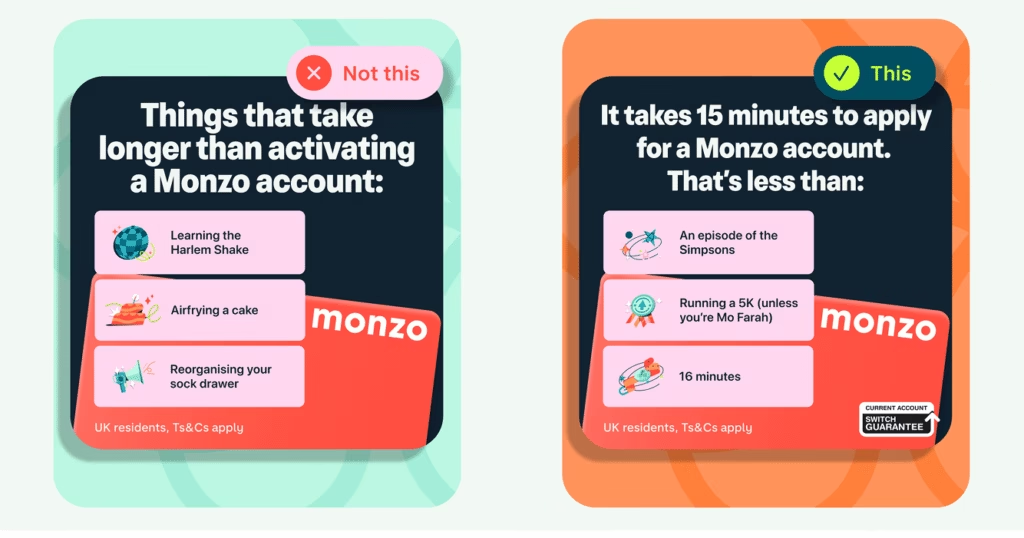
And this 👇
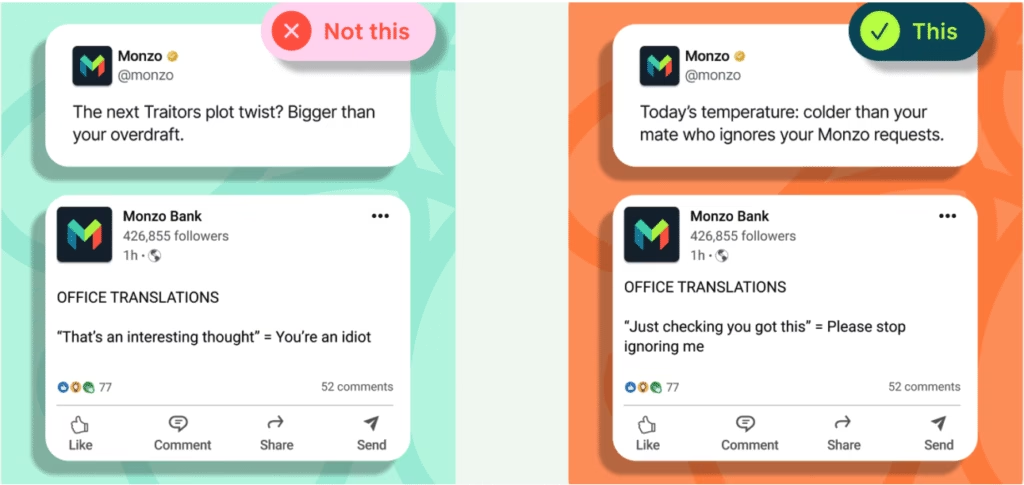
And this 👇
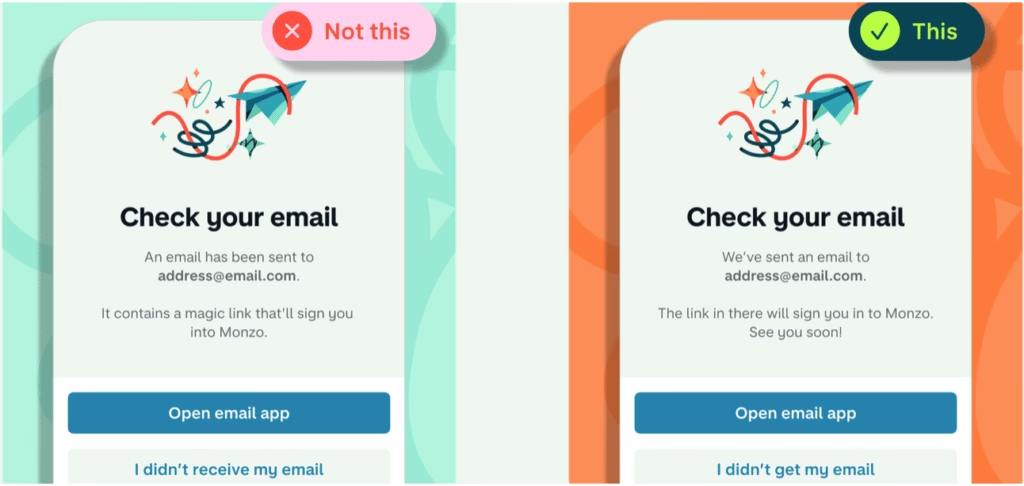
To a copywriter that’s got that automaticity thing on lock and years of being able to spot patterns and nuances under their belt, these are a goldmine of voice guidance.
You can see that Monzo prefer timeless references to flash-in-the-pan zeitgeist references.
You can see that they hate humour that punches down.
You can see that they prefer simpler language wherever possible. (Receive < get.)
And by osmosis, you get a proper sense of how to write for Monzo.
The problem is, for non-writers and AI, these examples don’t quite land.
They rely on taste.
They rely on being able to spot the patterns.
And they rely on being able to follow that chain of thought from “oh, they don’t like Traitors jokes” to “OK, that’s because it’s too zeitgeist-y” to “OK, so the references have to make everyone feel included and seen” to “OK, but the jokes still need to feel more universal without losing specificity, we can’t go too broad” and fill in the blanks yourself.
And, to be fair to Monzo, in places, they get much closer.
Like this bit on avoiding passive language. (Which is great advice, btw.)
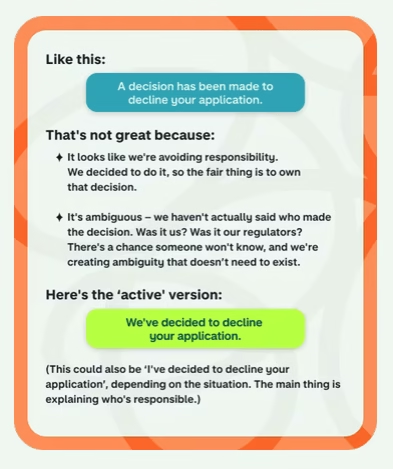
And they pair it with this:
There’s a funny thing that happens to our writing when we’re giving bad news, or talking about processes. We slip into what’s called the ‘passive’ voice, which basically means we don’t say who’s responsible for something.
We use the passive voice partly because we’re unconsciously distancing ourselves from the message. But that’s not fair for the reader, and what they need always comes first.
There might be rare occasions where we deliberately don’t want to say who’s responsible for something, but we usually slip into the passive by accident. So make sure you’ve got a really good reason for using it if you do.
It’s really, really good.
It’s empathetic to the writer so it doesn’t feel like it’s admonishing them. It shows them why Monzo don’t like the passive voice. And it shows them how to fix it.
If we had to nit-pick, we’d say that it does assume that people can spot the passive voice/know what it is.
If they just added the classic “if you can add by zombies after the verb and the sentence still makes sense, it’s probably passive”, it would make this section useful to everyone.
❌ A decision has been made by zombies to decline your application. (Makes sense = passive.)
✅ We’ve decided by zombies to decline your application. (Doesn’t make a jot of sense = active.)
TLDR: Monzo’s brand voice document is great for writers. But for non-writers and AI, it’s like our boy Pedro says…
Two small changes to your brand voice guidelines that make it better for people and AI
When we first started writing brand voice guidelines, we did almost exactly what Monzo did.
We wrote brand voice guidelines for copywriters and people who write all day.
(Like we said before, reading the first version of the Monzo brand voice document in 2018 was like hearing Sgt Pepper’s for the first time. It changed our world.)
But then we heard Ann Handley say something (we think in Everybody Writes) along the lines of “everybody at your company writes for your brand now. Every customer support email, every tweet, even the privacy policy… that’s all your brand voice.”
And we realised that documenting brand voice just for copywriters wasn’t really solving anything.
So we started adapting them for non-copywriters, too.
We started with some research into how people like to learn things and then worked backwards from that.
We found out that there’s a body of research that focuses on the question of “how do you teach people to understand new things properly?”
And what they found is that the most effective method is showing people good and bad examples so our brains can work out the difference.
But there’s nuance there, too.
Because while good and bad examples are better than no examples, they’re not perfect.
When you show someone a good and a bad example, what tends to happen is that they learn how not to be wrong, rather than how to get it right.
And that’s how you end up with copy that’s trying too hard. Or copy that tips from warm into sickly sweet, or witty into smug.
It’s steering towards the idea of right, but it massively overshoots.
So we came up with the idea of Goldilocks examples AKA examples that are wrong, too much and just right.
By doing that, we can take away that binary sense of right and wrong and replace it with a mental framework and a target to aim for instead.
Think of it like somebody saying “I like my coffee strong”.
You know they don’t want it milky, but do they want it black? Do they mean just a splash of milk?
Now imagine you’ve made them a cup of coffee before and they’ve said “that’s too strong, even for me” then you know how to calibrate it.
It’s the same thing with Goldilocks examples of your voice. Too little, too much, just right.
And when you pair the Goldilocks stuff up with an explanation? Hoo boy. That’s when our brains really light up.
Without the explanation on why the voice is the way it is, we learn to copy patterns. With an explanation, we learn the principle and thinking behind it.
That leads to something called Adaptive Expertise, where we can modify our approach when the situation changes. When we need to write in the brand voice for a new brief or for a different format, we can adapt without missing a beat.
But people who only learn what to do and not why develop Routine Expertise, where they’re good in familiar situations but struggle when things change.
Back to the coffee example, if the person said “I like my coffee to be almost undrinkably bitter” and you know you’ve got a slightly more mellow Brazilian coffee, you might put a bit less milk in to get the same result. That’s adaptive expertise in action.
And the best thing? This makes your brand voice guidelines waaaay better for AI, too.
Everything we’ve just described about our brains lines up really nicely with the current research on how to get AI to be more precise and accurate.
The first thing is called few-shot prompting. And research found that giving AI examples of the desired output dramatically outperforms giving it instructions alone.
However, we’ve all seen AI overcorrect.
You tell it to “be warm and witty” and show it a fairly crappy corporate line as a “don’t do this,” and it’ll conclude that warmer and wittier is always better. So it goes FULL warm and witty, all the way to 11.
But when you show it the sweet spot? That gives it a much smaller space to play in and gets you much, much more consistent and on-brand results.
Quick tangent: the other day, we were training a brand voice copybot and it said “this copy might be too wanky” because we’d told it to talk to users “like in a pub garden.” Like we said, it likes to overcorrect.
But does this mean you need to provide examples of every kind of copy?
It would if it weren’t for the explanation on why the examples aren’t right (or are bang-on).
In fact, a research team found that adding your reasoning to examples — AKA explaining why the good version works and why the bad one doesn’t — significantly improves the quality of the output again.
And it’s the same for AI as it is for our brains: without the explanation, it just copies a pattern. We try to make coffee the same shade every time.
With the rationale, AI has a way to think that it can apply to new situations. It can adapt to the beans and the milk and whatnot.
(Yeah, this coffee metaphor is getting tired.)
In other words, AI isn’t just mimicking your brand voice once it knows the rationale, it’s starting to think like your brand.
Which makes a huuuuge difference.
OK, let’s see it in action
We’ve just waffled on for 1000+ words on theory, so let’s see it in action.
(Side note: this email is structured to help you learn about brand voice using the exact same techniques. How very meta.)
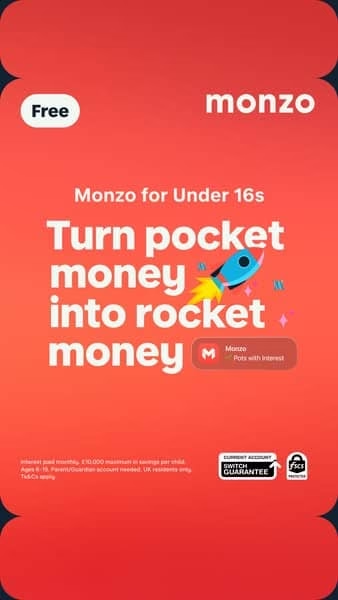
We set ourselves a brief to get AI to write a paid social headline for Monzo’s Under 16s account.
We used this Monzo ad as our control of what “good Monzo” looks like.
We ran this experiment three times with the exact same brief.
All we did was to change the amount of context it had every time.
For the first test, we gave it all the Monzo brand voice documentation and let it use its training data on Monzo. But we didn’t give it any examples.
Here’s where we ended up:
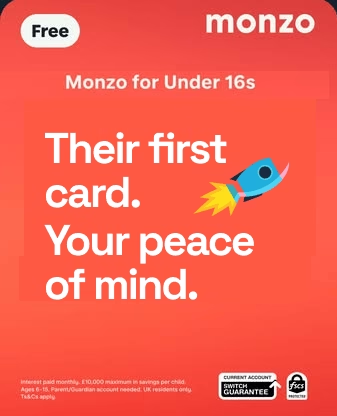
This is the same problem we ran into the week before last. AI isn’t really using Monzo’s voice, it’s just doing an approximation of what it thinks it should say.
That said, it’s not awful.
It definitely tries to make an emotional connection with the parent setting the card up. It’s trying to nod to the fact that this is a big next step.
It’s just not getting there because it doesn’t have what it needs.
So, we ran a second test.
This time, we gave it all the same information from test one plus we pasted in the good/bad examples from Monzo’s tone of voice document.
Here’s what we got back:
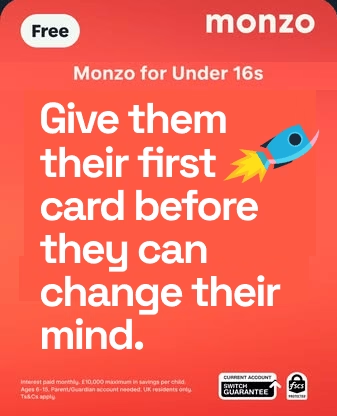
You can immediately see it’s learned something. It’s picked up that Monzo likes a chatty, knowing tone. There’s an attempt at a wink-wink to the parents in there.
But in doing that, it’s turned the emotion from pride into every “ugh teenagers” cliche it’s ever read.
It’s a classic example of that over-correction thing we talked about earlier. It’s seen corporate copy as “bad” and legged it too far the other way.
In fact, looking at it objectively, it might even be a bit worse than version 1.
So then we ran a third test where we gave it everything above plus a Goldilocks Example and explanation we’d put together based on Monzo’s voice.
Here are Goldilocks examples showing the range of our voice.
Too dry: Set them up for financial security.
Why it misses: Gets to the right emotional truth but it’s utilitarian and emotionless. No hint of humour or knowing wink. No nod to the parent child relationship.
Too much: A bank account that’ll outlast this Roblox phase.
Why it misses: This tries too hard. The Roblox reference shifts the parent role from proud enabler to eye-rolling and exasperated. It sacrifices the emotional truth about independence and growth for a joke.
Just right: Turn pocket money into rocket money.
Why it works: Pocket money nods to the child still being young, but rocket money evokes growth and possibility and pride. It’s the whole story. It’s also not sentimental, but the ad is written from a place of parental pride. That detail transforms the mundane into everyday magic, it’s a moment of unexpected delight.
And here’s what we got back:
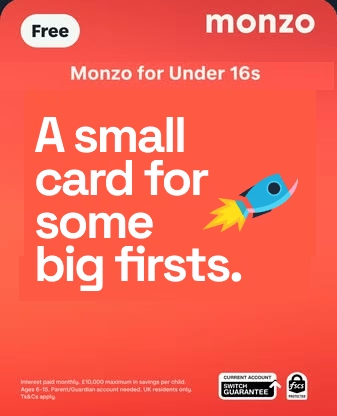
Boom.
Now, is it “Turn pocket money into rocket money”? Not quite. That’s the kind of line a copywriter writes.
But it gets the product in there, nails that “they’re growing up” emotional core, does it in a very Monzo-y voice, is a neat example of that “everyday magic” from their brand voice guidelines and uses that clever antithesis technique we looked at in Naked Paper’s ad.
And what’s really interesting is that it doesn’t do the overly hype-y “Small card for all those big firsts” thing that AI tends to do. It doesn’t disregard all sense of subtlety to write something it thinks is a zinger.
It’s genuinely really good. It doesn’t read like AI at all.
(Full disclosure: we honestly didn’t expect it to be this good.)
☝️ And that’s the difference that Goldilocks Examples and giving it the thinking makes.
So next time you’re briefing in some copy (or you’re editing your brand voice document to give to AI), make sure you give it:
- A bad example, a good example and a too-far example
- Explanations on why these aren’t right or are just right
(Pro tip: AI is pretty good at helping you spot the difference between copy you feel is right and stuff that feels off, even if you can’t explain why. If you struggle to get what’s in your head into the prompt, start there instead.)
Right, go and give that a go and see if you get better copy back.
And if you don’t get something genuinely much better back, hit reply and let us know. We’ll help you figure out why.
ICYMI: we’ve launched a new service helping with exactly this.
We’ll get under the hood of your voice and document it in a way that people and AI can use and then train AI to write better copy for your brand.
If you want to see what that looks like for your brand, grab 30 mins on our calendar and we’ll run you through the whole thing, from the brand voice documentation all the way through to seeing the chatbots in action.
(Don’t have a voice you’re happy with yet? We can help with that as well. We’ll help you figure it out and nail it first, then we’ll train AI to write in that new voice.)