💡 This week’s big (half-formed) idea: brand voice is a really bad way to describe what brand voice is. But so is almost every other way to describe it.
I read this post by Harry Ashbridge a few weeks ago and it’s been banging around in my head ever since.
He said:
Writing is foundational to how a business operates, and the phrase ‘tone of voice’ just doesn’t do that justice.
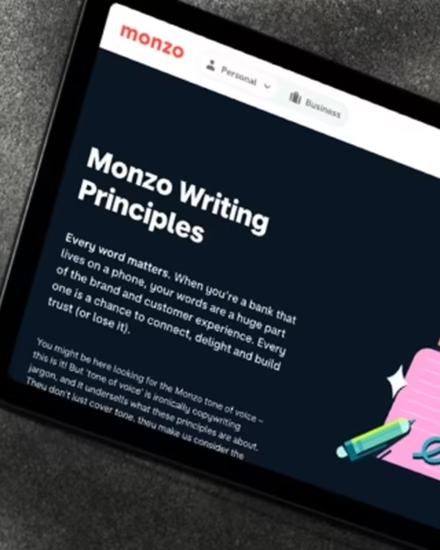
(FYI, Harry is the brain behind Monzo’s voice document, so he knows his stuff.)
And reading this was a huge aha moment for me.
Because I’m not sure any buzzword does it justice.
Tone of voice. Brand voice. Tone and voice. Brand language. Brand tone of voice. Verbal identity…
And look, I’ve been writing copy for coming up on two decades now. (Eeesh. Getting old.)
And nearly half of that time has been spent predominantly working on brand voices.
I am, for my sins, a brand voice nerd.
And yet, during a talk last week, somebody asked me the difference between brand voice and tone of voice and I just did not have a good answer.
Eventually I sputtered some variation of “voice is who you are. Tone is how you adapt that to different situations.”
Which is true. Ish. Kinda. But not really.
What I really wanted to say is that it’s all the same thing, ultimately.
Or, more accurately, they’re theoretically different but functionally, they’re pretty much the same.
Because when you break it down, where does voice stop and tone start?
Going further still where does tone end and plain good writing begin?
Then you throw in messaging on top of that. And positioning.
Oh! And let’s not forget punctuation? What about our favourite move, the parenthetical aside? (Like this, where you kind of stage whisper to the reader.) Is that voice or tone or good writing?
See how confusing it gets?
Like, have you ever seen a bit of copy and thought “the voice is good, but the tone is wrong”?
Yeah, me neither.
Brand language, brand voice, tone of voice, verbal identity, whatever… all pretty much boil down to the same thing: writing good for your brand.
But the real problem is that having all these similar but technically different terms for what makes for good brand copywriting has made it harder for everyone to adapt to the tidal wave that is AI.
Because while we’ve all heard “AI needs to know your tone of voice” a million times, I’m not sure anyone has the same idea of what that actually looks like in practice.
Notice how designers don’t have this kind of semantic nightmare? Isn’t that ironic?
It’s worth briefly noting just how much irony there is in the fact that the phrases brand voice, tone of voice, verbal identity, etc… have all been thought up by copywriters.
This is a profession where before you’re allowed to touch a keyboard, you have to meet your fellow copywriters under the light of a full moon, drag a page of the thesaurus across your palm and make a blood oath to the principles of simplicity, clarity and specificity…
And yet we somehow also decided to give one of the foundational ideas about what we do 5 different names and then (as if that wasn’t confusing enough) just use them interchangeably.
Designers don’t have this problem.
Our Figma-loving brethren might have a few words for their equivalent (brand guidelines, style guides, etc…)
But there’s a shared understanding of what all those terms mean because you can find examples of brand guidelines everywhere on the internet.
Designers share them as part of their portfolio. They’re all over Dribbble and Behance and Instagram.
There’s a whole repository of them, in fact.
Brand voice has nothing like that.
I’d wager that almost everyone reading this email has seen maybe a handful of brand voice guidelines outside of their own.
And I’d wager even more that less than 10% of you have ever seen in-depth verbal identity guidelines.
Like I said, I’ve been what you might call unnaturally obsessed with brand voice stuff for coming up on a decade.
I’ve read pretty much every book ever written on brand voice (I think). I even wrote one myself back in the day.
I’ve signed NDAs before getting client brand voice documents. I’ve hunted for leaked versions of brand voice guidelines in forums. I’ve emailed brands I love offering a kidney in exchange for a look at their internal docs. (Alas, I still have both kidneys.)
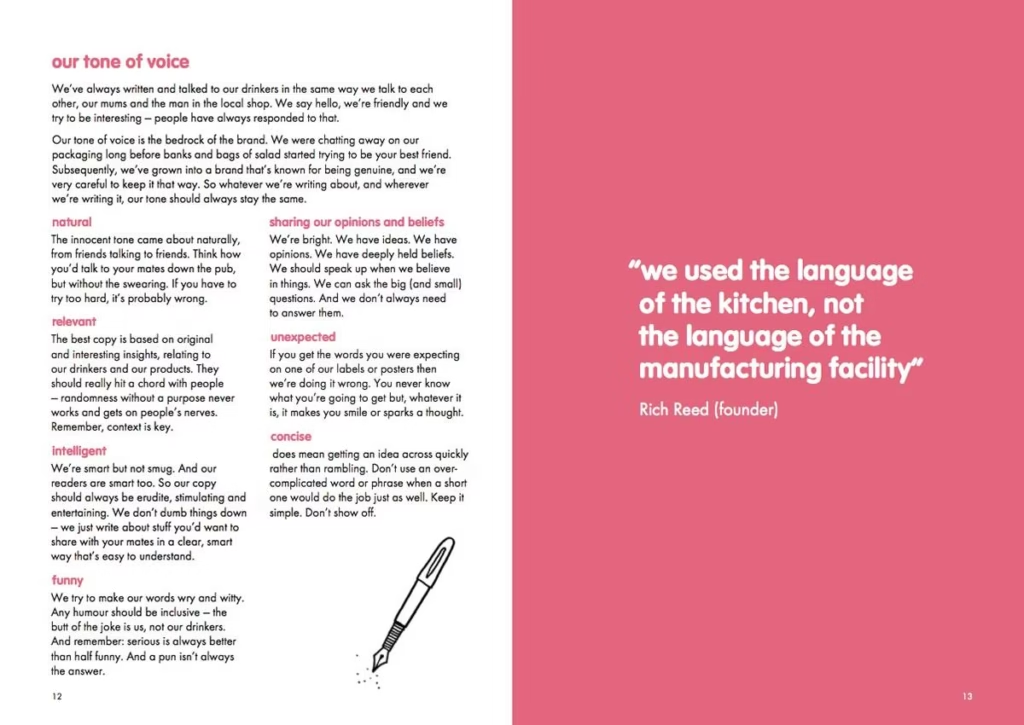
I also spent a lot of time in my early days trying to figure out how to document voice in a way that actually made writing for a brand easy for everyone, not just copywriters.
And that’s a big problem.
Sure, the fact that we can’t agree what to call it is funny and ironic.
But what’s worse is that we all have no collective idea of what brand voice guidelines really look like.
And that kinda makes sense, if you think about it. Why would brands share something that gives away thinking and strategy and that gives them an edge?
Sure, a brand could borrow your rules on how to use their logo consistently from your guidelines or they might borrow your rules for spacing and typography, but the guidelines won’t give them your thinking.
But voice is a bit different.
The best voice documents aren’t just things like “we’re chatty and funny”. They train people (and robots) to think like the brand. To understand your messaging strategy. and the thinking behind it.
They’re more than just rules. They tell people how to create and come up with ideas for your brand.
And that’s something that brands, for very good reasons, don’t want to share with their competition.
But not having a standard idea of what brand voice guidelines look like also means, as a collective, we have no idea of what good brand voice guidelines look like either.
So then you find yourself hearing things like “AI needs to know your brand voice to write like you” and wondering why those few pages on voice from your visual branding agency aren’t doing the trick.
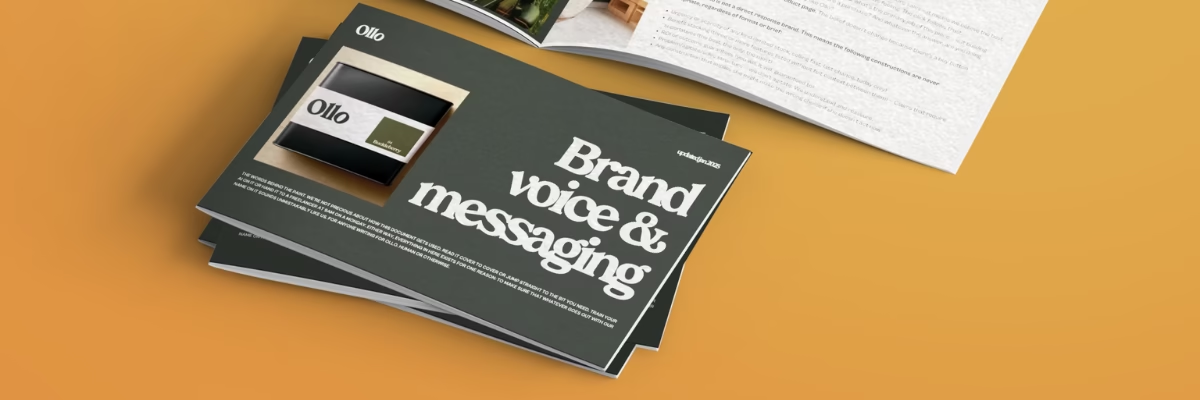
So here’s a look at a verbal identity we put together for a fake brand that was in no way whatsoever inspired by Lick Paint.
☝️ We took our usual voice process and did proper work on this brand voice for a few weeks around our client work, including real customer research, competitor research, etc… so it’s as accurate as possible to the real thing.
(I’m almost gutted this paint brand doesn’t exist now.)
But see how it’s almost the language equivalent of brand design guidelines?
It’s got mission, story, voice, voice of customer research, annotated examples of good copy, goldilocks examples, house style, messaging, verbal assets…
Basically everything that falls under the umbrella of how a brand writes.
That’s what makes the difference.
Because language is so flexible, so contextual, so malleable… you need guidelines that handle more than just “we’re friendly, funny and plain-spoken”.
Think of an apology email. How are you funny in an apology email?
And, looping back, that’s why brand voice isn’t such a great term. It sounds like one thing, like a single dial you can turn up or down.
But your brand voice is actually kinda everything.
It’s words you use habitually. It’s also the words you choose not to use. It’s references to films and music and books and culture that you make. It’s the trends you don’t engage with. It’s the jokes you make. It’s how you use punctuation. It’s how you say things when something goes wrong. It’s the way your sentences feel and the rhythm of your copy. It’s the beliefs underneath all of it. It’s how you see your relationship with your customers. It’s the power dynamics of how you write to your customers.
That’s all wrapped up in “brand voice.”
But none of that gets put into most brand voice guidelines we’ve ever seen.
Why this slightly incoherent rambling matters more than ever right now
If I’m hand-on-heart honest, brand voice wasn’t always as important as it is now.
Or maybe it was important, but it just wasn’t as urgent.
A lot of our brand voice work pre-AI was broken into two groups:
Group 1: growing brands who wanted help figuring out how to sound and stand out from the crowd. It’s branding, strategy and positioning work, applied to how you write.
(Which is why we call it verbal identity, not brand voice. Voice is one part of it, sure, but it’s more how your brand’s identity comes across in all of its words.)
Group 2: huge enterprise brands with hundreds of employees who write to customers every day. These briefs were less creative work and more refining what was already there and turning it into a consistent language system that everyone from marketing to legal to customer support could use consistently.
Now, that’s not to say that smaller brands didn’t need the complexity of a full verbal guidelines document. Not at all.
It’s just that (at the risk of sounding like our parents) back in those days, every bit of copy a brand put out had been written by a person.
And the brands with the best voices almost always had somebody who lived and breathed the brand and who had a full set of brand voice guidelines in their head, even if they’d never been documented.
They’d know which jokes were on-brand. They’d know which words are just not quite right. They’d know when to be more chatty and to dial it back a bit.
They’d know all that because they spent years honing their own taste and style and approach to copywriting.
And because of that they had a gut instinct for what was on-brand and what was off-brand and what was “this is nearly there, but that one little detail is derailing the whole thing. We just need to soften that to a word that’s less sure and a little softer and it’s all good.”
But now, there’s a lot of copy that isn’t written by humans.
And we’ve said before that we love that AI helps growing brands do more cool stuff that they wouldn’t have had the budget for before.
We’re not anti-AI copywriting. Not at all, really.
It’s just that AI is really bad at picking up on the nuances and specificities of your brand voice from your website and guidelines, no matter how in-depth they are.
(As we saw with the Monzo experiment a few weeks ago. And the Surreal experiment before that. AI gets voice in the ballpark, but it’s not you.)
Which means the only way we’ve found to make sure AI can actually replicate your voice (and, frankly, your team too) is to document it the same way designers document design guidelines and then convert those guidelines into markdown documents structured so AI can use them.
Rules, principles, thinking, contexts, use cases, edge cases, good/bad/not quite right examples with annotations, rules on what not to do (which humans don’t really need)…
Basically, we try and distil everything that a good copywriter has absorbed into their gut over years of working with a brand and get it written down in a way that doesn’t rely on taste or experience to apply.
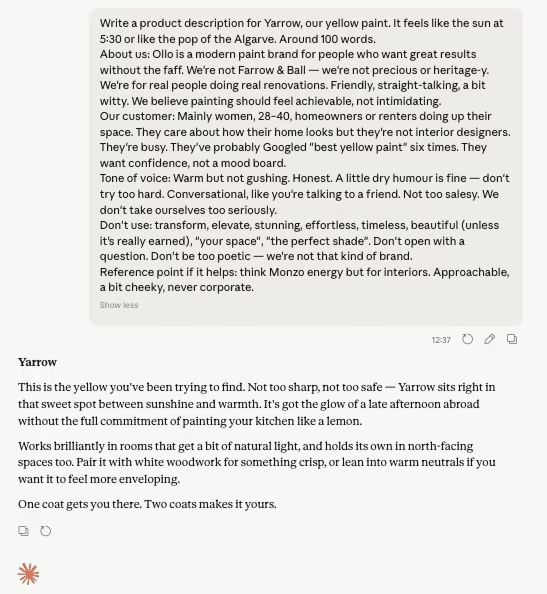
And that means you can go from writing looooong prompts every time and getting copy like this:
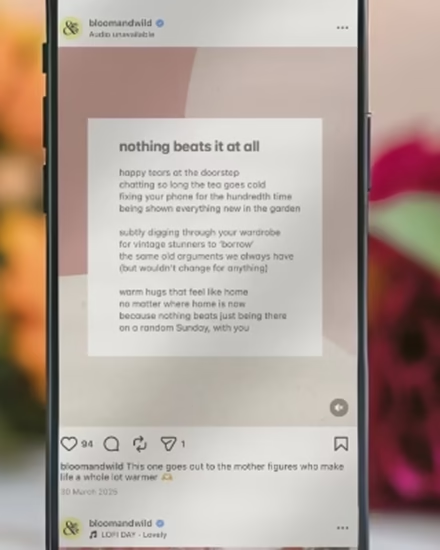
But when you upload your guidelines, you can just give it a simple brief and get on-brand copy back like this 👇
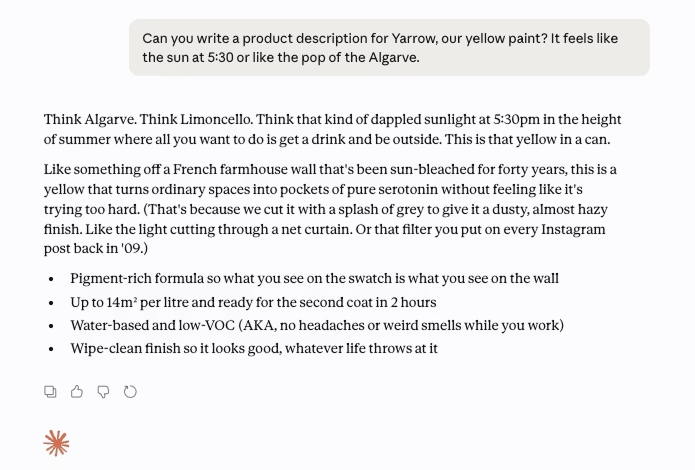
It’s not bad, right?
Now all that’s left to do is find a decent name for it.
Verbal AI-dentity anyone?
Helping brands figure out their voice, document it and then train AI to sound like them is quickly becoming our bread and butter.
And if that’s something that would help you, we’d love to help.
But we also know that budgets are having to work a lot harder right now.
So here’s a pro tip you can do yourself:
Start a Google Doc and paste in every bit of copy you get back from AI and leave notes on what you do and don’t like.
Add some of your favourite copy from your website, social media, emails, etc… too and do the same thing.
It doesn’t have to be 2000 words like the emails we send, just a bullet on “that joke is very us, but we wouldn’t use that word” or “this reads a bit cold and salesy”.
Get as specific as you can. (Even “this word doesn’t feel like us but I can’t place why, it just feels a bit too much” is better than “I don’t like this”.)
Don’t do anything with it yet, just keep adding to it.
Then, after a few weeks, take that document, upload it to AI and ask it to spot patterns between all of your feedback.
However, here’s the real nuance: don’t ask AI to define your voice. We’ve tried that every which way and it always comes back with something super generic or wildly off base.
(Probably partly because there’s almost no brand voice guidelines or agreed-upon idea of what brand voice is in its training data. Funny that.)
But AI is genuinely good at is spotting patterns.
And if you’ve got a doc full of honest, specific notes that you’ve collected over weeks and months, that document is your brand voice and your taste in its rawest form.
And when you give that to AI, you don’t get back “you’re warm, witty and direct.”
You end up with observations on how you use language, like: “you like to use self-deprecating humour but never at the customer’s expense” or “you like to avoid corporate filler words like ‘solutions’ and ‘journey’ or “you prefer to start descriptions by painting a scene rather than talking about a benefit”.
Those more granular observations are things that actually make a difference to the quality and on-brand-ness of copy you get from AI.
(Even better, stack them with the tips we sent over a few weeks ago about your copy philosophy and giving it examples and you’ll start getting some really decent stuff.)